
White oak, northern red oak, bur oak, and coast live oak are among the many types of oak trees you might encounter. Telling them apart takes a combination of clues: leaf shape, acorns, bark, and where the tree grows. Knowing your oak also helps you make informed decisions about tree health care and maintenance. A species adapted to California’s dry foothills may have different needs from one native to moist eastern woodlands.
Below, you’ll find common American oaks, California natives, and regional guidance for Northern California, Seattle, and Portland, followed by practical advice for choosing an oak for your property.
How Many Types of Oak Trees Are There?
There are several hundred oak species worldwide, all belonging to Quercus, the botanical genus that groups true oaks together. Around 500 is a useful approximate figure, although the total varies as botanists revise classifications. The Arnold Arboretum describes the genus as containing some 500 species.
The trees below are a selection of recognizable species, not a complete inventory. Scientific names help distinguish them because common names such as white oak and live oak can describe more than one kind of tree.
Not sure if your tree needs professional attention?
A Plus Tree’s ISA Certified Arborists serve homeowners across the West Coast. A free assessment takes 15 minutes and gives you a clear answer.
How to Identify an Oak Tree
To identify an oak, compare several mature leaves, examine available acorns, and check the bark and branching against the tree’s location. No single feature reliably distinguishes every species.
Think of identification as assembling a picture from several pieces. A leaf may suggest a possibility, while the acorn, bark, and habitat help confirm it.
Compare Leaf Shapes, Edges, and Undersides
Start with the leaf’s outline. Lobes are the projections along its edges, while the spaces between them are called sinuses. Notice whether the lobes are rounded, pointed, shallow, or deeply separated.
One useful distinction between the red and white oak groups is at the leaf tips. White oak group leaves generally lack bristle tips, while red oak group leaves typically have tiny bristles at the tips of lobes or teeth. Here, “white oak” can describe either the broader group or the individual species Quercus alba.
Turn the leaf over, too. A pale underside, fine hairs, or small hair tufts where veins meet can help distinguish similar species. Examine several mature leaves because their shape can vary with age and position on the tree. Some oaks have unlobed leaves, so the absence of familiar rounded projections does not rule out an oak.
Examine Acorn Shapes and Caps
Look at both the nut and the cup-shaped cap holding it. Is the nut long and tapered or short and rounded? Does the cap cover a small portion of the nut or much of its length? Check whether its surface is smooth, scaly, or fringed.
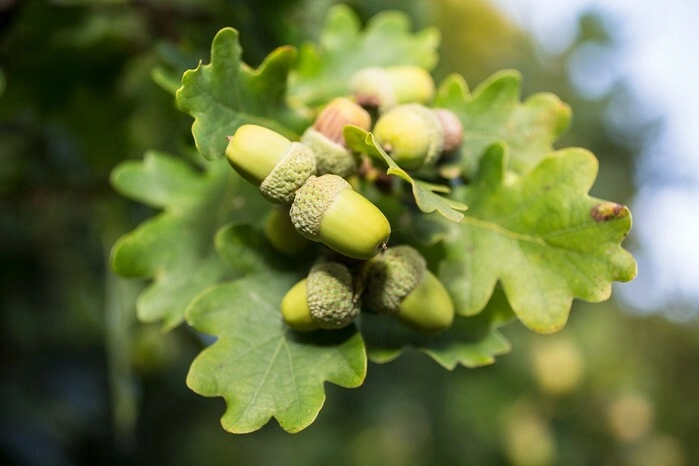
Comparing different types of oak acorns can help confirm an identification when leaves look similar. A fallen acorn is most useful when you can confidently connect it to the tree above, especially where several oaks grow together.
Development time provides another clue, although it usually requires observing the tree over time. Red and white oak acorns usually follow different timelines: white oak group acorns typically mature in one growing season, while red oak group acorns usually take two. There are exceptions: coast live oak belongs to the red oak group but matures its acorns in one season.
Check Bark, Branching, and Local Growing Conditions
Bark can support an identification, but its appearance changes as a tree matures. A young oak may have relatively smooth bark that develops ridges or plates with age. Compare trees at a similar stage of growth, and examine the surface without cutting or scraping it.
Step back to see the branching pattern and crown, the upper portion formed by branches and leaves. Then consider the setting: coastal woodland, dry foothill, mountain slope, or landscaped yard.
Location narrows the possibilities, although planted trees can grow well outside their native range. Record these observations alongside photographs of leaves, acorns, and the whole tree. If identification will affect construction or landscape changes, professional arborist consulting services can help connect those observations with a property-specific assessment.
Common Oak Species Across the United States
These oak species come from different parts of the country. Being common in one region does not make a species native or suitable everywhere. Use this comparison to narrow the possibilities, then check the profiles for additional characteristics and growing needs.
| Oak species | Native US region | Leaf clue | Acorn or bark clue |
| White oak | Eastern and central states | Rounded lobes without bristles | Light gray, scaly bark |
| Bur oak | Central and eastern states | Rounded lobes with a broad upper portion | Fringed acorn cap |
| Swamp white oak | Eastern and central states | Shallow lobes and pale, hairy undersides | Acorns on noticeable stalks |
| Northern red oak | Eastern and central states | Pointed, bristle-tipped lobes | Broad, shallow acorn cap |
| Pin oak | Northeastern and north-central states | Deep spaces between pointed lobes | Small acorns with thin caps |
| Black oak | Eastern and central states | Bristle-tipped lobes, often glossy above | Dark, deeply ridged mature bark |
| Southern live oak | Southern coastal regions | Thick, mostly unlobed leaves | Elongated acorns in bowl-shaped caps |
White Oak (Quercus alba)
White oak has rounded leaf lobes and pale gray bark that becomes scaly with age. This deciduous tree, which loses its leaves seasonally, develops a broad crown and can exceed 100 feet on favorable sites.
Native to eastern and central North America, it generally performs well in moist, well-drained, acidic soil. Its scientific name distinguishes it from other members of the white oak group, including Oregon white oak.
Bur Oak (Quercus macrocarpa)
Bur oak’s fringed acorn cap is a particularly useful identifying feature. Its large leaves have rounded lobes, often with a narrower middle and a broad upper portion.
This deciduous native of central and eastern North America commonly reaches around 70 to 80 feet, with a similarly substantial spread. It tolerates a range of soils, including alkaline conditions that trouble some other oaks, but needs generous growing space.
Swamp White Oak (Quercus bicolor)
Turn over a swamp white oak leaf and you’ll see the contrast behind its name: a green upper surface and a pale, softly hairy underside. Its leaves have relatively shallow lobes or coarse rounded teeth.
This eastern and central North American species often reaches 50 to 60 feet. It tolerates seasonal flooding and some drier conditions, but its affinity for moist sites does not mean every permanently waterlogged location is suitable.
Northern Red Oak (Quercus rubra)
Northern red oak combines bristle-tipped leaf lobes with acorns held in broad, shallow caps. Mature bark can develop long ridges with lighter surfaces.
Usually around 50 to 70 feet tall in landscapes, this deciduous tree is native to eastern and central North America and is also planted elsewhere. It can provide relatively quick shade where soil, moisture, and growing space suit it.
Pin Oak (Quercus palustris)
Pin oak has deeply cut leaves with pointed lobes. Its branching pattern is also distinctive: lower branches commonly angle downward, middle branches extend outward, and upper branches rise.
This deciduous tree generally reaches 50 to 70 feet. It favors acidic soil and can develop iron chlorosis, a form of leaf yellowing, in alkaline conditions. Soil compatibility is therefore an important consideration before planting.
Black Oak (Quercus velutina)
Black oak develops dark, deeply ridged bark and leaves with bristle-tipped lobes. Its acorn caps cover a larger portion of the nut than the shallow caps of northern red oak.
Native to eastern and central North America, this large deciduous tree can reach 50 to 100 feet. It is a different species from California black oak, so check the scientific name when comparing references.
Southern Live Oak (Quercus virginiana)
Southern live oak is recognizable by its spreading branches and thick, mostly unlobed leaves. Its crown can become much wider than its height, creating the expansive canopy associated with southern coastal landscapes.
It commonly reaches 40 to 80 feet. Its evergreen habit means it retains foliage through winter, although older leaves are still shed and replaced. Other species called live oak have different native ranges and growing requirements.
Native Oak Trees in California
The types of oak trees in California reflect the state’s varied environments, from coastal woodland to dry foothills and mountain forests. UC Oaks’ California oak species guide compares identification and ecology for eight common and important species. Some retain green foliage through winter, while others lose their leaves seasonally.
White and red oaks are useful starting groups, but they do not encompass every oak. California also has members of the golden oak group, including canyon live oak. “Live oak” describes an evergreen habit rather than a single equivalent botanical group.
Coast Live Oak (Quercus agrifolia)
Coast live oak has leathery, often cupped leaves with spiny edges. Small tufts of hairs at vein junctions on the underside help distinguish it from similar evergreen oaks.
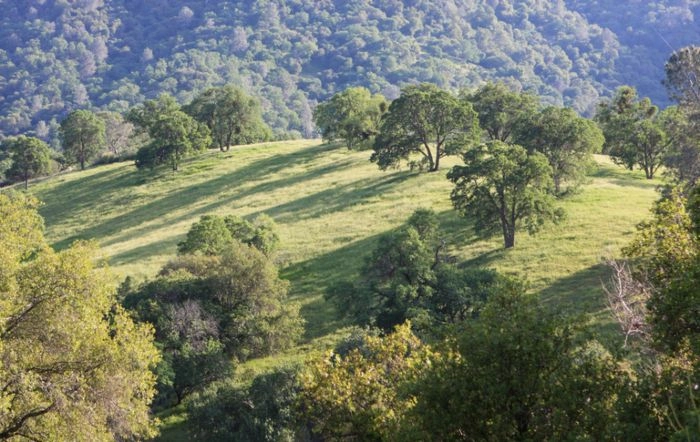
It develops a broad crown in coastal California settings. Examine several mature leaves because their shape and degree of spininess can vary.
Valley Oak (Quercus lobata)
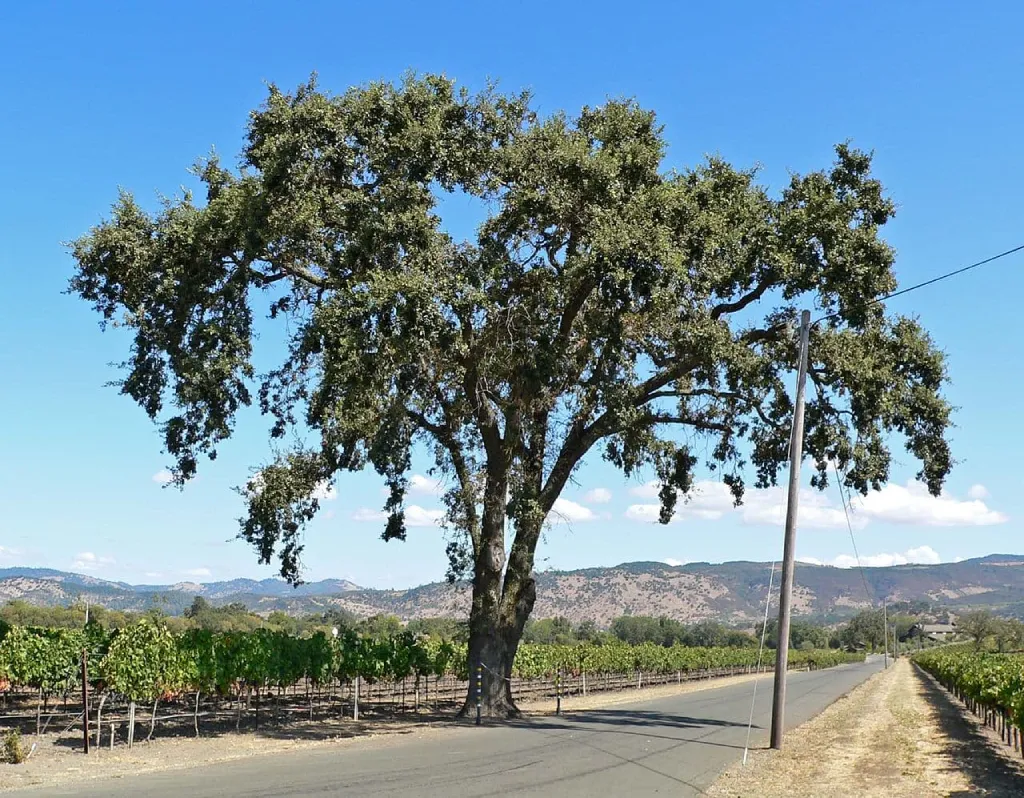
Valley oak has rounded, irregularly lobed leaves and a spreading crown with substantial, sometimes arching branches. Its long, tapered acorns provide another useful clue.
This deciduous California native becomes a very large tree, sometimes exceeding 100 feet. It is associated with valleys and deeper soils, where access to moisture supports growth through the dry season.
Blue Oak (Quercus douglasii)
Blue oak’s dull blue-green foliage helps distinguish it from neighboring oaks. Its leaves often have shallow, irregular lobes, and mature bark is light gray and divided into small plates.
Commonly around 20 to 60 feet tall, this deciduous California native is associated with dry foothill woodland. Established trees tolerate seasonal drought, but newly planted trees still need appropriate establishment care.
Interior Live Oak (Quercus wislizeni)
Interior live oak has thick evergreen leaves that are often flatter and more elongated than coast live oak leaves. Their edges may be smooth or spiny.
It generally lacks the characteristic dense hair tufts found on coast live oak’s leaf undersides. Inland foothill and woodland settings provide a useful geographic clue.
California Black Oak (Quercus kelloggii)
California black oak has pronounced, bristle-tipped leaf lobes and loses its foliage seasonally. It is associated with foothill and mountain forests and commonly reaches around 60 to 90 feet. Despite the shared common name, it is distinct from eastern black oak, Quercus velutina.
Canyon Live Oak (Quercus chrysolepis)
Canyon live oak carries leathery evergreen leaves that may have smooth or spiny edges, even on the same tree. Its thick acorn caps often have a golden, fuzzy appearance.
It can grow as a spreading tree or a smaller, shrubby plant depending on conditions. Its variable leaves illustrate why leaf shape alone cannot reliably distinguish every oak species.
Oregon White Oak (Quercus garryana)
Also called Garry oak, Oregon white oak has rounded leaf lobes and a broad, spreading crown. It is deciduous and commonly grows around 40 to 90 feet tall.
Its native range extends from British Columbia through Washington and Oregon into California. The name therefore describes a species with a much wider distribution than Oregon alone.
Engelmann Oak (Quercus engelmannii)
Engelmann oak has leathery, gray-green or blue-green leaves with edges that are often smooth or gently wavy. It generally forms a rounded crown and reaches roughly 15 to 50 feet.
Native to Southern California and northern Baja California, it is usually evergreen but may shed foliage during drought. It is not a typical Northern California native.
Which Oak Trees Grow in Your Area?
Geography helps narrow an identification, especially in natural woodland. In streets, parks, and gardens, you may encounter species planted far outside their native ranges. Use the regional examples below to build a shortlist, then compare the tree’s identifying features.
Which Oaks Are Common in Northern California?
Common types of oak trees in Northern California include coast live oak, valley oak, blue oak, interior live oak, California black oak, and Oregon white oak. Canyon live oak is another important species across suitable woodland and mountain settings.
| Setting | Representative oaks to consider |
| Coastal and Bay Area woodland | Coast live oak; Oregon white oak in parts of the region |
| Inland valleys and foothills | Valley oak, blue oak, interior live oak |
| Mountain and mixed woodland | California black oak, canyon live oak |
These habitats overlap. Elevation, exposure, and soil moisture help explain why different oak species can grow within a relatively short distance of one another.
Oak Trees Around Seattle
Seattle’s planted oaks include northern red oak and eastern white oak, both documented in the city’s planting records. Oregon white oak is native to the broader Pacific Northwest. An oak growing in a Seattle neighborhood should therefore be identified by its features rather than assumed to be a native species.
If a planting label or property record says white oak, look for the scientific name. Quercus alba and Quercus garryana are different species, and the common name alone may leave that distinction unresolved. A dated planting record can be useful supporting evidence, provided it clearly refers to the tree you are examining.
When identification is part of planning changes around an established tree, our team providing tree care in Seattle and Tacoma can assess the tree and its surroundings.
Oak Trees Around Portland
Oregon white oak has a strong local presence around Portland. The city’s heritage-tree records include mature examples, while northern red oak also appears as a planted landscape species. Both are worth considering when identifying an oak in the city, but they have different native origins.
Heritage-tree records can provide named local examples for comparison. Use records for trees that are still present, and compare more than overall size. An old oak growing in open space can develop a much broader crown than a younger tree growing among buildings or other trees.
If an oak shares space with paving, buildings, or a proposed landscape project, local tree care in Portland can help you assess its condition and growing space before deciding what changes are appropriate.
How to Choose an Oak Tree for Your Property
The easiest oak to grow is usually one whose needs match the site. Appearance matters, but soil, climate, mature size, and available water determine whether a promising young tree can develop well over time.
Match the Species to Your Climate, Soil, and Water Availability
Before choosing a species, check the conditions it will actually experience:
- Climate: Consider winter cold, summer heat, and exposure.
- Soil: Check drainage and pH, especially for species sensitive to alkaline conditions.
- Sunlight: Assess the planting spot across the day.
- Water: Plan for establishment watering and the tree’s longer-term needs.
- Nearby planting: Consider whether lawn or garden irrigation will reach the oak’s root zone.
Native habitat is a useful starting point, but a compacted urban yard may differ greatly from nearby woodland. Established California native oaks can also be sensitive to frequent summer irrigation, particularly around the trunk. Their needs differ from those of newly planted trees.
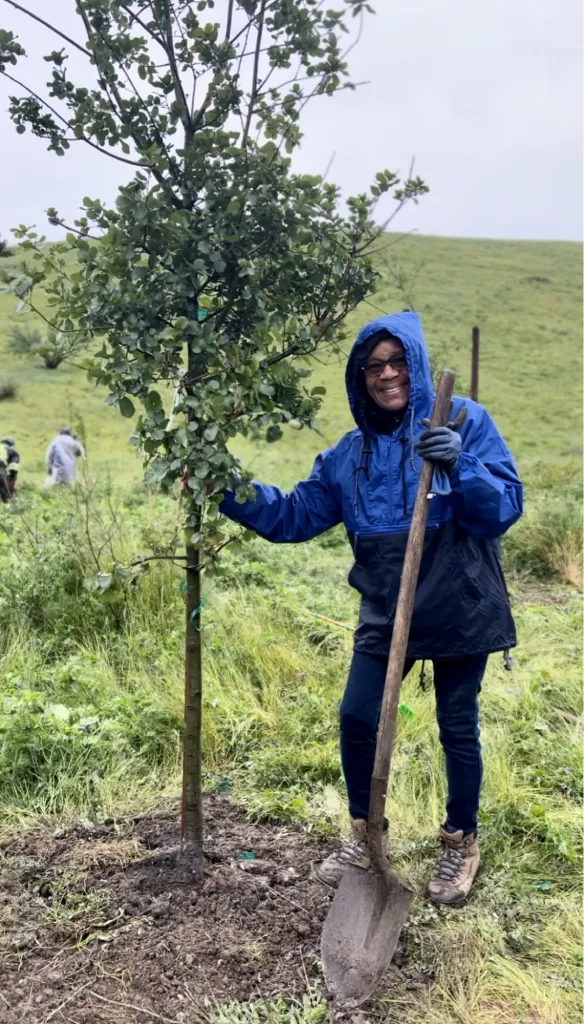
Our tree planting and transplanting services include site assessment and species selection. Matching the tree to existing conditions early helps avoid problems that become harder to address as it grows.
Allow Room for Mature Roots and Canopy
A nursery tree’s current size tells you little about the space it will eventually need. Check its expected mature height and width, then consider buildings, overhead utilities, paths, and neighboring properties. A narrow crown does not necessarily mean the tree needs little root space.
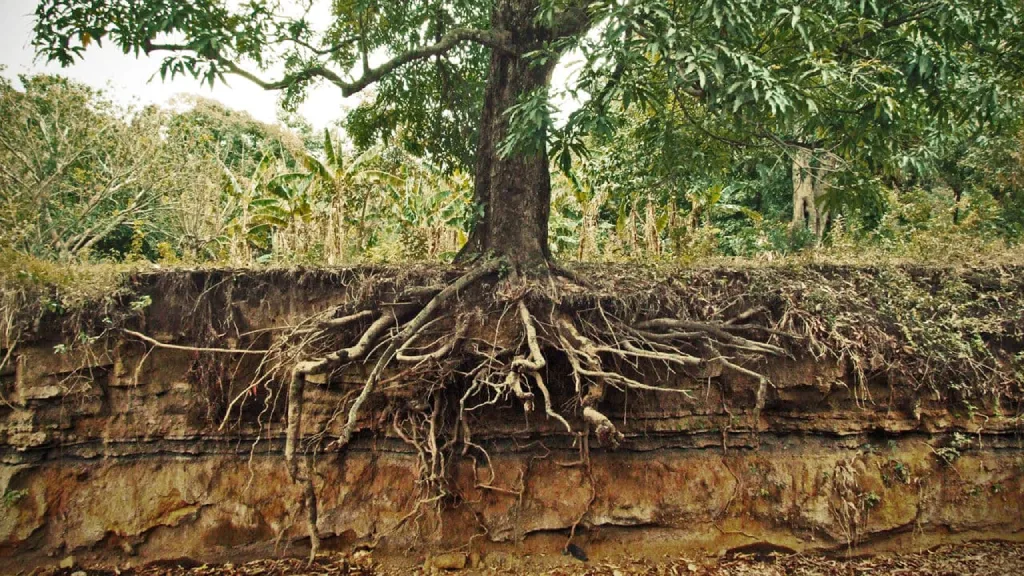
Understanding how far tree roots spread also helps you look beyond the planting hole. Roots can extend outside the canopy, and their distribution changes with soil conditions and available moisture. There is no single planting distance that suits every oak and every property.
For a small yard, be realistic about the space available. A compact cultivar may be worth investigating, but confirm its mature dimensions. Routine heavy pruning should not be the plan for keeping a naturally large tree within an unsuitable space.
Consider Growth Rate, Seasonal Shade, and Wildlife Value
Growth speed is one consideration among several. A faster-growing oak may provide shade sooner, but growth depends on soil, moisture, climate, and establishment. Deciduous species allow more winter light through their branches, while evergreen oaks provide more consistent foliage cover.
Consider this hypothetical example: two site-compatible oaks could both grow in a spacious yard beside a sunny patio. If winter sunlight matters, the deciduous option may better suit the space. If year-round screening is the priority, the evergreen option may be more useful.
Oaks can also support insects, birds, and other wildlife, giving your choice value beyond shade. Once you have selected a suitable species, planting the tree correctly helps give it a healthy start. Choose a tree you can accommodate for decades, with enough room for its mature form.
Frequently Asked Questions
Can Different Oak Species Form Hybrids?
Yes. Compatible oak species can cross-pollinate and produce hybrids, usually within the same botanical group. Their mixed traits can make identification more difficult.
Is Tanoak a True Oak?
No. Tanoak belongs to Notholithocarpus, while true oaks belong to Quercus. Although it produces acorns, it is a related tree in a different genus.
What Is the Difference Between an Oak Species and a Cultivar?
A species is a distinct botanical group. A cultivar is a named selection grown for particular traits and may come from one species or a hybrid.
Get Help Identifying or Selecting an Oak Tree
Start with several leaves, an acorn if available, and a clear photograph of the whole tree. Combine those observations with location and growing conditions, and you will often narrow the possibilities considerably.
If the identification remains uncertain, or you are choosing an oak for a particular space, A Plus Tree can help assess the tree and site. Knowing which oak you have is a useful first step toward giving it appropriate care and room to grow.
Get a Free Tree Assessment — No Obligation
Tell us about your tree. One of our ISA Certified Arborists will review your situation and get back to you within 24 hours.