
A tree that looked healthy last year is suddenly thinning at the top, dropping leaves early, or losing whole branches, and nothing you do seems to help. That slow, unexplained decline is often the first sign of armillaria root rot, a fungal disease that attacks a tree from below the soil where you cannot see it happening. The whole thing can feel unsettling, because the damage stays hidden and the tree may look mostly normal until it is already seriously weakened.
The good news is that this is a well understood problem. Once you know what the fungus does, what the warning signs look like, and which situations call for a professional, you can make calm, informed decisions about your tree.
A Plus provides tree pest and disease management for exactly these situations, and catching the signs early gives you the best chance to act before the fungus compromises the entire tree.
What Is Armillaria Root Rot?
Armillaria root rot is a disease caused by a group of soil fungi in the genus Armillaria, sometimes called honey fungus. The fungus lives in the soil and in dead or living wood, and it feeds on the roots and the base of the trunk. Because it works underground, most homeowners never notice it until the tree above ground starts to struggle.
Understanding how the fungus behaves, what people mean when they call it oak root fungus, and which trees it targets will help the rest of the warning signs make sense.
How the Armillaria Fungus Infects and Decays Roots
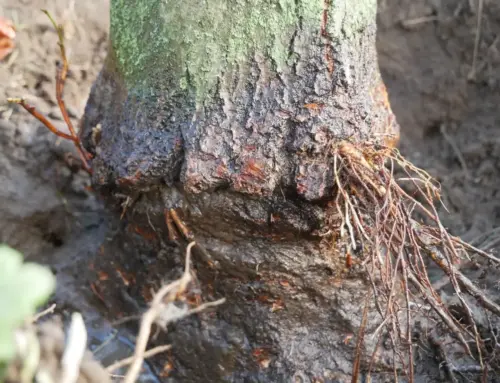
The armillaria fungus spreads through the soil and colonizes a tree’s root system, usually starting at the smaller feeder roots and working its way toward the larger structural roots and the root collar, which is the flared area where the trunk meets the ground.
As it grows, it decays the wood and destroys living tissue around the cambial zone. The nearby phloem and xylem tissues move sugars, water, and minerals through the tree, so damage in this area disrupts the tree’s basic transport system.
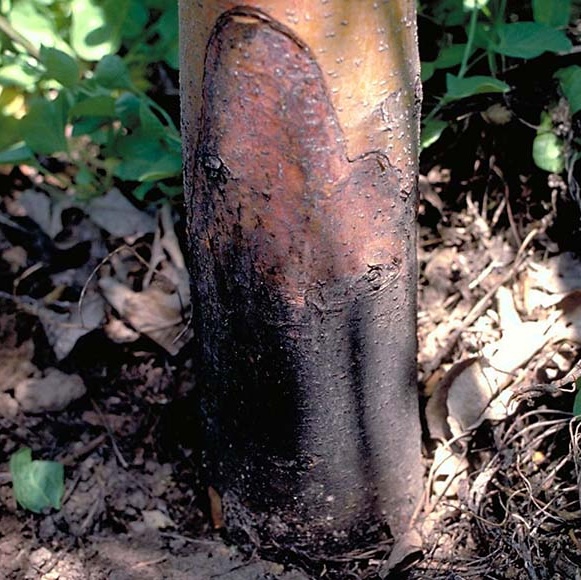
A helpful way to picture it is a girdle. When the fungus kills that living layer all the way around the base of the tree, it has the same effect as cutting a complete ring through the bark. Water and food can no longer travel properly, so the canopy above slowly starves even though the roots look intact from the surface. That is why a tree can appear fine for a long time, then decline quickly once the damage reaches the root collar.
Is Oak Root Fungus the Same as Armillaria Root Rot?
For most practical purposes, yes. Oak root fungus is the common West Coast name for Armillaria mellea, the species behind most armillaria root rot cases in California. It earned the name because it is so common on native oaks, though it attacks a wide range of trees and shrubs, not oaks alone.
The one distinction worth knowing is that armillaria root rot can be caused by several Armillaria species, while oak root fungus points specifically to that one very common species. If a neighbor or a nursery mentions oak root fungus, they are almost always describing the same disease covered here.
Which Trees Are Most Susceptible?
Armillaria has an unusually broad appetite, so the list of hosts is long. In California and the Pacific Northwest, the trees most often affected include oaks, fruit and nut trees such as stone fruit, apple, and walnut, along with many maples, pines, and other landscape species. Grapevines and some shrubs are vulnerable too.
Susceptibility has as much to do with the tree’s condition as its species. A tree under stress from drought, overwatering, compacted soil, or root injury has a harder time defending itself. Trees planted where an infected tree or old stump was removed are also at higher risk, because the fungus can survive for years in that leftover wood and reach the new roots nearby.
Not sure if your tree needs professional attention?
A Plus Tree’s ISA Certified Arborists serve homeowners across the West Coast. A free assessment takes 15 minutes and gives you a clear answer.
What Does Armillaria Root Rot Look Like?
Because the disease starts below ground, the earliest clues usually show up in the canopy long before you find anything at the base of the tree. Learning to read both the above ground symptoms and the below ground signs gives you a much clearer picture of what is happening. It helps to start with the subtle changes that tend to appear first.
Early Armillaria Root Rot Symptoms
The first armillaria root rot symptoms are easy to miss because they look like general stress. You might notice slightly smaller or paler leaves, a canopy that seems a little thinner than usual, reduced growth compared with previous years, or dieback that starts in the upper and outer branches. Sometimes only one side of the tree shows it at first.
None of these signs prove armillaria on their own, because branch dieback and other canopy symptoms can have many causes, including drought, poor drainage, soil compaction, and other disorders. What makes them worth a closer look is when they show up gradually, get worse season over season, and do not improve after you rule out signs of overwatering or correct other obvious irrigation problems. A tree in steady decline for no clear reason is worth watching carefully.
Symptoms Above Ground vs. Signs Below Ground
Above ground, the tree shows the results of the damage rather than the disease itself. Expect thinning foliage, undersized or yellowing leaves, early fall color, branch dieback, and slowed growth. In a stressed tree during a hot summer, you may even see a fairly sudden collapse where large sections brown out over a few weeks.
Below ground and at the base of the trunk, you find the fungus itself. This is where the real confirmation lives, in the form of white fungal growth under the bark, dark root like strands in the soil, decayed roots associated with fungal root rot, and sometimes clusters of mushrooms. The canopy tells you something is wrong, while the roots and root collar tell you whether armillaria is the reason.
Signs Found Beneath the Bark
The most reliable evidence sits right at the root collar, under the bark at the base of the trunk. Checking here means carefully clearing away soil and mulch from the trunk flare and looking at the wood surface underneath. Two features stand out, and finding either one strongly points to armillaria. Do this gently and only at the surface, since deep digging around roots can injure a tree that is already struggling.
White Mycelial Fans
Mycelial fans are flat, fan shaped sheets of white or cream colored fungal tissue that grow between the bark and the wood. Peel back a piece of loose bark at the base of an infected tree and they look almost like a layer of white paint or a paper fan pressed against the wood. They often give off a distinct mushroom smell.
These fans are one of the clearest signs of the disease. Healthy trees do not have them, so their presence at the root collar is a strong indicator that armillaria is at work.
Black Rhizomorphs (Shoestring Roots)
Rhizomorphs are the feature that gives this fungus its shoestring nickname. They are dark brown to black, round, and stringy, and they look remarkably like bootlaces running along the surface of roots or through the surrounding soil. Snap one and the inside is often white.
Rhizomorphs are how the fungus travels from one root system to the next, which makes them both a diagnostic sign and part of the reason the disease spreads. Seeing them wrapped around roots near a declining tree is another strong clue.
Mushrooms at the Base of the Tree
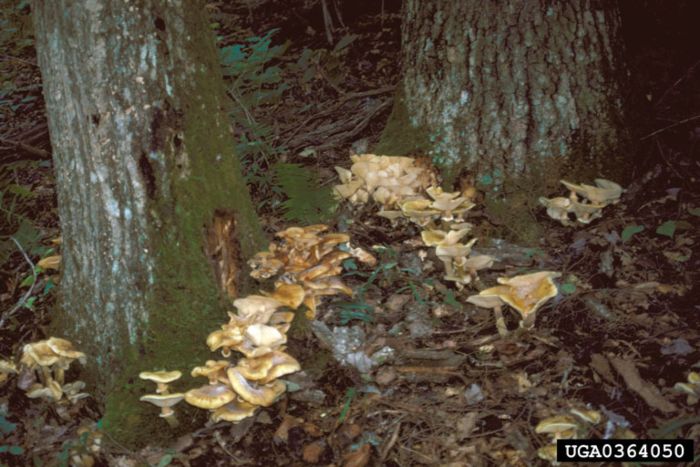
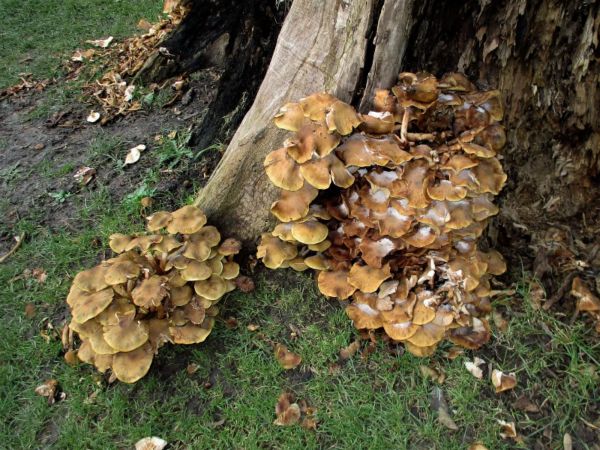
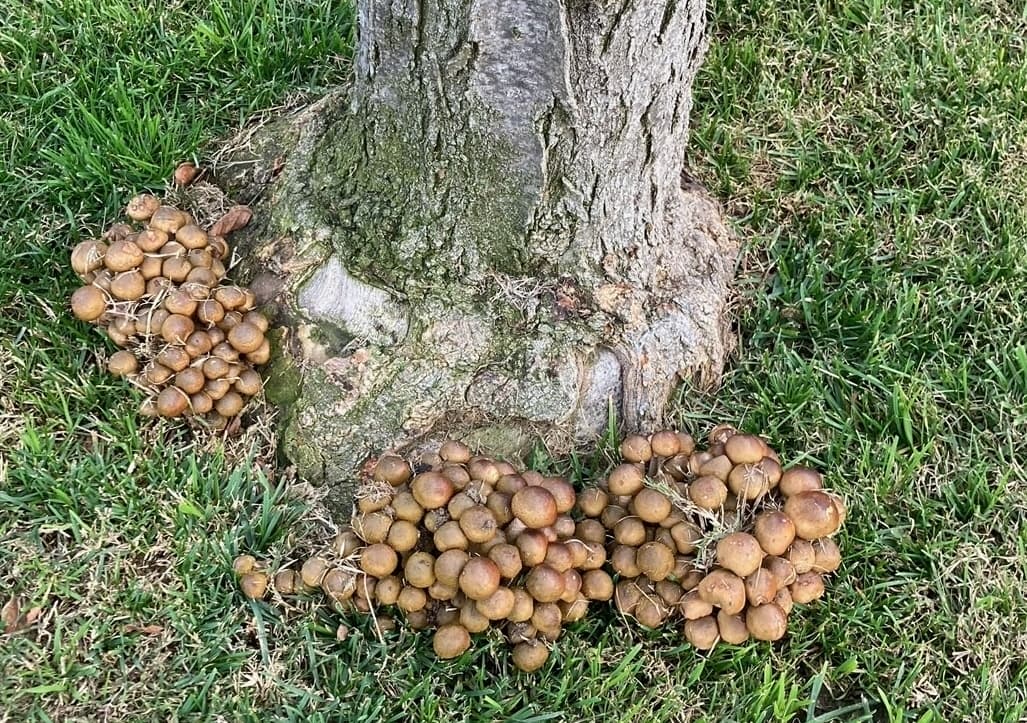
The most visible sign, when it appears, is a cluster of honey colored mushrooms at the base of the trunk or over the root zone. They are golden to tan brown, grow in clumps, have gills underneath, and usually carry a small ring on the stalk. More broadly, visible fungal fruiting bodies usually signal advanced decay, although the damage may extend above or below where they appear. In California and the Northwest, armillaria mushrooms tend to show up in fall, often after the first good rains.
Here is what this looks like in real life. An oak leafs out normally in spring, browns across one whole side by late summer, and then produces a tight cluster of amber mushrooms at its base after the first fall storm. Keep in mind that these mushrooms are seasonal and unreliable, so their absence does not mean the tree is clear.
How Symptoms Progress Over Time
Armillaria usually advances in a predictable direction, from the feeder roots inward to the major roots and finally to the root collar. As more of the root system and trunk base lose function, the canopy decline you see above ground grows to match it. Early on, that might be one thinning limb. Later, it can become widespread dieback.
The pace varies a great deal. A large, well established tree in good conditions may persist for years with slow decline, while a young or heavily stressed tree can fail within a single season. The important pattern to watch is direction. Symptoms that keep spreading rather than stabilizing point to an active problem that deserves professional attention.
How Armillaria Root Rot Spreads and What Increases Risk
Knowing how the fungus moves helps explain why one infected tree can put its neighbors at risk and why the disease lingers on a property. Armillaria spreads mainly through direct root contact and through those shoestring rhizomorphs, with airborne spores playing only a minor role. Site conditions then decide how much trouble it causes, starting with the most common route of all, root to root contact.
Spread Through Root Contact
The most common way armillaria moves between trees is direct contact between root systems. When the roots of an infected tree touch or grow against the roots of a healthy one, the fungus can cross from the diseased wood into the new host. This happens naturally in landscapes where trees are planted close together and their roots overlap underground.
For that reason, a diseased tree in a row or grove raises the risk for the trees right beside it. If one tree in a cluster is declining and shows armillaria signs, the surrounding trees are worth checking as well.
Spread by Rhizomorphs
Rhizomorphs let the fungus travel on its own, without needing root to root contact. These black, cable like strands grow out through the soil from a colonized root or stump and can reach nearby roots a fair distance away. When a rhizomorph contacts a healthy root, it can penetrate and start a new infection.
Think of them as underground extension cords the fungus uses to search for its next food source. This ability to move through soil is a big reason armillaria can persist and spread across a property even after an obviously sick tree is gone.
What Role Do Spores Play?
The mushrooms produce spores, but spores are a minor player in how this disease spreads in a home landscape. They mostly matter for colonizing fresh stumps or large wounds on other trees, and they are more important for long distance spread between areas than for moving the fungus from tree to tree in your yard.
In practical terms, the roots and rhizomorphs already in your soil are the real concern. Focusing on infected wood, stumps, and root systems addresses the spread that actually threatens your trees.
Environmental Conditions That Increase Risk
Armillaria becomes more damaging when trees are stressed and when the fungus has plenty of wood to live in. Poorly drained or frequently saturated soil is a common culprit, since constant moisture stresses roots and favors the fungus. Drought stress works against the tree from the other direction, leaving it too weak to wall off an infection.
Old stumps and buried roots act as a reservoir, feeding the fungus for years, which is one reason stump and root grinding after a removal helps clear the source. Recent construction, grade changes, soil compaction, and root damage from digging all add stress and create entry points. A property with several of these factors gives armillaria a real advantage, which is why site management matters as much as the tree itself.
Diagnosing Armillaria Root Rot
Getting the diagnosis right matters, because the general symptoms of decline overlap with several other tree problems. Some checks are safe and simple for a homeowner, while confirming the disease and judging whether a tree has become hazardous is work for a trained arborist. Knowing where that line falls is the best place to begin.
What You Can Safely Check Yourself, and What Needs a Pro
On your own, you can safely observe the canopy for thinning and dieback, look for honey colored mushrooms at the base in fall, and gently clear a little soil and mulch away from the trunk flare to check for white mycelial fans or dark rhizomorphs at the surface. Documenting these observations with photos over a few weeks gives useful information.
What is not a do it yourself task is major digging around roots, cutting into the trunk, or deciding whether a large tree is safe to keep. Excavating deeply can injure a stressed tree, and judging structural stability takes training. When your surface checks point toward armillaria, that is the moment to bring in a professional rather than digging further.
Armillaria vs. Other Causes of Tree Decline
Plenty of problems cause the same slow canopy decline that armillaria does, which is why the below ground signs matter so much. Drought stress, poor drainage, girdling roots that wrap around and choke the trunk, soil compaction, and other root diseases such as Phytophthora can all mimic the general look of a struggling tree. On oaks specifically, sudden oak death is another cause of decline worth ruling out.
What sets armillaria apart is the physical evidence at the root collar, the mycelial fans and rhizomorphs, along with the clustered mushrooms when they appear. A canopy in decline is a reason to investigate, while those specific signs at the base are what actually confirm the fungus is involved.
How Arborists Confirm the Disease
A certified arborist confirms armillaria by combining the aboveground picture with a careful look at the root collar. They will assess the pattern and history of decline, then expose the root crown enough to check for the characteristic white fans between bark and wood and for rhizomorphs on the roots and in the soil.
In less clear cases, a sample of the affected tissue can be sent to a lab to identify the fungus. Alongside the diagnosis, the arborist evaluates how much of the root system and trunk base are compromised, which is the information that determines whether a tree can be managed or has become a safety concern.
When to Schedule a Professional Inspection
Schedule an inspection when you see steady, spreading canopy decline that does not respond to better care, when mushrooms or mycelial fans appear at the base, or when a tree develops any lean or looseness at the soil line. Larger trees near homes, driveways, play areas, or walkways deserve prompt attention because the risk to people and property is higher.
A Plus offers arborist consulting to evaluate declining trees and confirm what is going on. Getting a professional read early gives you more options and helps you avoid a surprise failure later on.
Treating Armillaria Root Rot: What Actually Works
Honest expectations help here, so it is worth stating clearly that there is no product that cures armillaria root rot. Effective armillaria root rot treatment is about managing the tree and the site to slow the disease, extend the tree’s useful life where possible, and remove trees that have become unsafe. The first question most homeowners have is whether an infected tree can be saved at all.
Can an Infected Tree Be Saved?
The realistic answer is that armillaria cannot be eliminated from a tree, but a lightly affected, otherwise healthy tree can sometimes be kept going for years with good care. Trees caught early, with limited root damage and no structural concerns, respond best to stress reduction and site improvements.
A tree with extensive root and root collar decay is a different story. Once a large share of the anchoring roots are compromised, decline and eventual failure become likely no matter what you do. Setting realistic goals with an arborist, whether that means preserving a tree or planning its removal, leads to better decisions than hoping for a cure that does not exist.
Cultural and Site Management for Infected Trees
Since no spray solves the problem, the most useful treatment is improving the conditions the tree lives in so it can better resist the fungus. That means reducing stress, managing moisture, and relieving anything that is working against the roots. Two practices tend to matter most, starting with the tree’s root collar.
Root Collar Excavation
Root collar excavation means carefully removing the soil and excess mulch that have piled up against the base of the trunk, exposing the root crown to air. Armillaria thrives in the moist, dark conditions found where soil is mounded against the bark, so opening up that area and letting it dry can slow the decay at the root collar.
This is a targeted, careful process best handled or guided by an arborist, since the goal is to relieve the trunk base without harming the roots. When done correctly, it removes some of the exact conditions the fungus depends on.
Irrigation, Drainage, and Soil Moisture Management
Water is one of the biggest factors you control. Overwatering and poor drainage keep the soil saturated, which stresses roots and encourages the fungus, while drought stress weakens the tree from the other side. Where irrigation is needed, slow, deep watering is preferable to fast, shallow watering, but the aim is steady, moderate soil moisture rather than extremes.
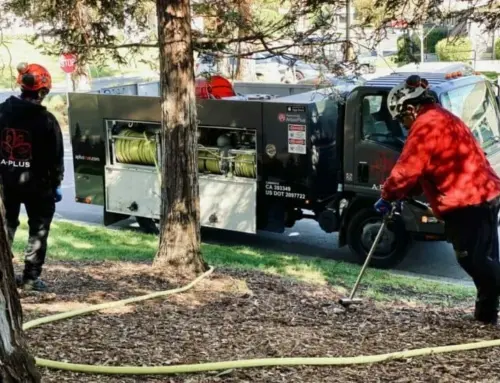
Improve drainage where water tends to sit, avoid watering right against the trunk, and match irrigation to the tree’s real needs and the season. For trees stressed by dry conditions, A Plus provides supplemental deep watering that delivers moisture to the root zone in a measured way. Correcting a moisture problem will not remove the fungus, though it often gives a struggling tree meaningful time.
Can Armillaria Make a Tree Unsafe?
Yes, and this is the part to take seriously. Armillaria decays the very roots and trunk base that anchor a tree in the ground and hold it upright. As that structural wood weakens, the tree can lose its grip on the soil and fail at the base, sometimes with little warning and even while parts of the canopy still look alive.
This makes armillaria more than a health issue on larger trees near people and property. A tree that is losing root anchorage is a candidate for whole tree failure in a storm or high wind, which is exactly the kind of hazard that warrants prompt professional assessment.
When Tree Removal Is the Safest Option
Removal becomes the right choice when an arborist finds extensive root or root collar decay, signs of instability, or advanced decline that management cannot reverse, especially when the tree could hit a home, vehicle, or walkway if it fell. In those cases, keeping the tree standing is a bigger risk than losing it.
When removal is warranted, A Plus handles professional tree removal safely, including taking out as much of the infected stump and root material as practical. Clearing that wood matters, because the fungus can keep living in what is left behind and threaten future plantings.
Preventing Armillaria Root Rot
Prevention rests on keeping trees strong and denying the fungus the wet, wood rich conditions it favors. You cannot sterilize a landscape, but you can strongly improve your trees’ chances with a handful of sound practices. Most of them start with the same foundation, a tree that is healthy enough to defend itself.
Reduce Tree Stress
A vigorous, unstressed tree is far better at resisting armillaria than a weakened one, so most prevention starts with basic tree health. Consistent, appropriate watering, a proper layer of mulch spread out over the root zone rather than piled on the trunk, and sound pruning all help a tree stay resilient. Protecting trees from drought stress and mechanical injury keeps their natural defenses working.
Steady care over time does more than any single treatment. A tree that stays healthy year after year gives the fungus far fewer openings to exploit.
Improve Soil Drainage and Root Health
Because saturated soil favors the fungus and stresses roots, drainage is one of the most valuable things to get right. Avoid low spots where water pools around trunks, redirect runoff where you can, and resist the urge to overwater established trees. Healthy, well aerated soil supports the kind of vigorous root system that fends off infection.
Relieving compaction and maintaining good soil structure around your trees supports stronger roots over time. Soil compaction reduces pore space, limiting water infiltration, oxygen availability, and root penetration. Roots that can breathe and drain are roots that resist disease.
Avoid Root Damage During Landscaping
Roots injured by digging, trenching, grade changes, or heavy equipment give armillaria easy entry points and add stress at the same time. Before any landscaping or construction near trees, plan around the root zones and keep machinery and excavation away from the critical area near the trunk.
Small changes in how a project is laid out can spare a tree’s roots a lot of harm. Protecting the root zone during the work is far easier than trying to help a tree recover after the damage is done.
Choose Less Susceptible Tree Species for the Site
On properties with a history of armillaria, species selection is a practical defense. Some trees tolerate the fungus better than others, so choosing more resistant species for a known problem area reduces the chance of repeating the same loss. A local arborist can point you toward species suited to your region and site conditions.
Matching the tree to the site also lowers stress overall, which reinforces every other prevention step. The right tree in the right place starts with an advantage.
Replanting After an Infected Tree Is Removed
Replanting in the same spot takes care, because armillaria survives in leftover roots and stumps and can infect a new tree planted into that ground. Removing as much of the old root and stump material as possible first is the single most important step, since it takes away the fungus’s food source.
When you do replant, favor a more tolerant species and give it excellent conditions to establish strong roots. A Plus offers tree planting and transplanting that accounts for site history, so a new tree gets the best possible start.
Suspect Armillaria Root Rot? Start With a Professional Tree Assessment
If your tree is showing steady decline, mushrooms at its base, or those white fans and shoestring strands at the root collar, the smartest next step is a professional evaluation. Armillaria hides its worst damage below ground, and only a hands on inspection can confirm the disease and tell you whether a tree can be managed or has become a safety risk. A certified arborist can assess the full picture, weigh the structural concern, and explain your options clearly rather than leaving you to guess.
You do not have to sort this out alone. Schedule a tree assessment with A Plus Tree, and our arborists will evaluate your tree, confirm what is happening at the roots, and recommend the safest, most sensible path forward.
Frequently Asked Questions
How Long Does It Take for a Tree to Die From Armillaria?
It varies. A large, healthy tree may decline over several years, while a young or stressed tree can fail within a single season once the fungus reaches the root collar.
Can a Tree Have Armillaria Without Producing Mushrooms?
Yes. Mushrooms are seasonal and unpredictable, so a tree can be infected without ever fruiting. The mycelial fans and rhizomorphs at the root collar are more reliable evidence than mushrooms.
Can Healthy Trees Become Infected?
Yes, though vigorous, unstressed trees resist far better. Stress from drought, overwatering, poor drainage, or root injury makes infection and serious decline much more likely to take hold.
Can Armillaria Survive in Old Stumps and Roots?
Yes. The fungus can live for years, even decades, in leftover stumps and roots, using that wood as a food base to infect nearby or newly planted trees.
Can You Cure Armillaria Root Rot With Fungicide?
No. There is no fungicide that reliably cures the disease. Management focuses on reducing stress, improving site conditions, root collar excavation, and removing trees that have become unsafe.
Get a Free Tree Assessment — No Obligation
Tell us about your tree. One of our ISA Certified Arborists will review your situation and get back to you within 24 hours.