
A tree that has looked fine for years starts thinning at the top. The leaves come in smaller, fall color shows up in August, and nothing obvious explains it. No pests, no disease, no stretch of missed watering. When the canopy says something is wrong and the usual suspects come up empty, girdling roots are worth investigating, because the cause sits at the base of the trunk where almost nobody looks.
A ground-level inspection can reveal warning signs, but roots hidden below the soil may need professional examination before treatment can be planned. The rest depends on an assessment that cannot be made from a photograph, which is where treatment or ongoing tree health care services come into the decision.
What Are Girdling Roots?
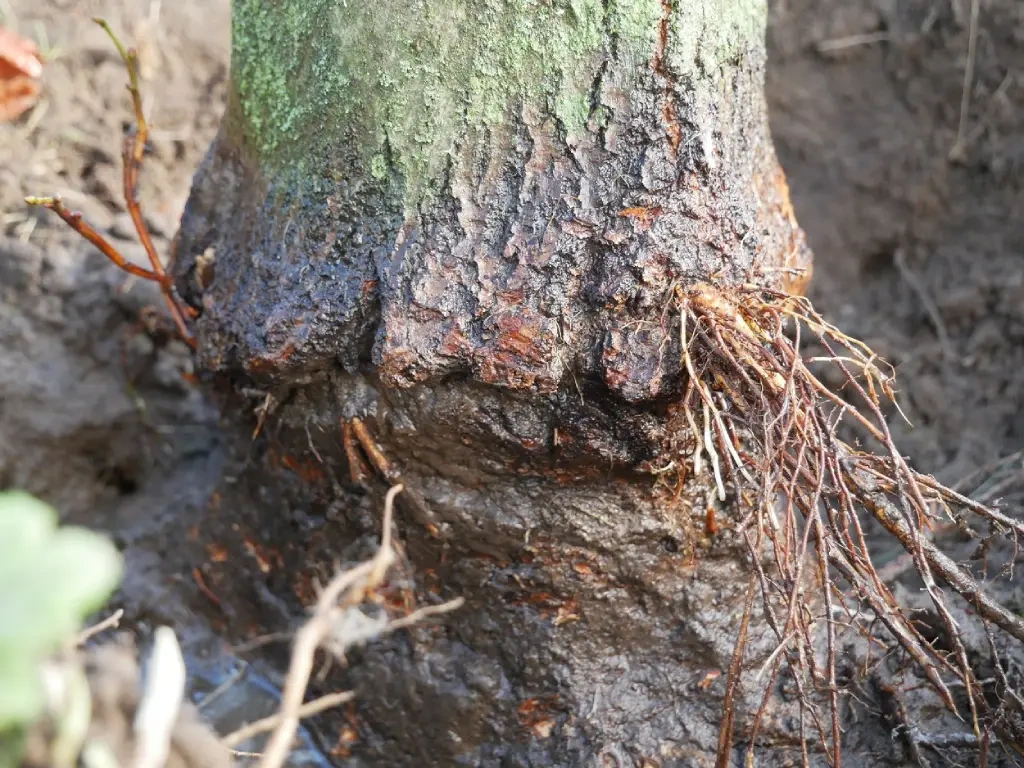
Girdling roots are roots that circle or press against the trunk instead of growing outward and away from it. Arborists usually call the damaging version stem girdling roots, since the root compresses the stem itself and interferes with the tissues that move water and food through the tree.
Not every root near the trunk qualifies. Roots that cross over other roots are common and rarely cause harm on their own. Bark damage from a forgotten nursery tie, a stake strap left on too long, or a mower strike looks similar at first glance and has a different source and a different fix, so it is worth ruling out before you treat roots as the problem.
How Roots Growing Around the Trunk Harm a Tree
Think of it like a ring that fit comfortably ten years ago. The ring did not tighten. The finger grew. Roots and trunks both add diameter every season, so a small root resting against the trunk at planting becomes a point of steady pressure as both parts thicken.
That pressure lands on the thin layers under the bark that carry water up from the roots and sugars down from the leaves. When those layers are compressed, transport slows at that one point on the trunk, and the parts of the tree served by that section receive less of what they need. Purdue’s guidance on stem girdling roots describes the process as slow by nature, which is why the effects take years to appear and why some trees show no canopy symptoms at all before they lean or fail in wind.
How Girdling Roots Differ From Normal Surface Roots
Surface roots are normal. Large structural roots naturally radiate away from the base and may show at the soil line; their visibility alone is not a reason to remove them or proof that the entire root system is healthy.
The distinction is position and contact. A root that runs tangent to the trunk, crosses one side of it, or sits hard against the flare is behaving differently from a root heading outward. A complete ring around the trunk is not required for damage, and the Missouri Botanical Garden guide to girdling roots makes the same point. Compression on one side of the stem still restricts flow to whatever that side supports.
Not sure if your tree needs professional attention?
A Plus Tree’s ISA Certified Arborists serve homeowners across the West Coast. A free assessment takes 15 minutes and gives you a clear answer.
How to Identify Girdling Roots
Look for roots pressing against the trunk, an uneven or missing root flare, and changes in the canopy, then have suspected compression assessed before considering root removal. Canopy symptoms alone never confirm the diagnosis, because thinning, scorch, and dieback have many possible causes. Evidence at the trunk carries far more weight than a list of leaf problems.
Three observations carry the weight, in this order:
- A root touching, crossing, or disappearing into the trunk
- A trunk base with no flare, or flattened on one side
- Canopy thinning, scorch, and dieback with no other explanation
Visible root contact warrants closer inspection, while a missing flare may also reflect deep planting. Canopy symptoms support further investigation but do not identify the cause.
Roots Pressing Against or Wrapping Around the Trunk
Gently pull loose mulch away from the trunk and inspect the exposed base. If finding the flare requires digging through soil or working around roots, have an arborist assess it. You are looking for any root that touches the trunk, runs along it, or disappears into it.
Root size at this stage matters less than root position. A root the thickness of a garden hose pressed flush against the stem matters more than a far larger root angled away from it. Growth across one side counts, and so does a root that vanishes under the flare rather than emerging from it.
A Missing Root Flare or Flattened Trunk Base
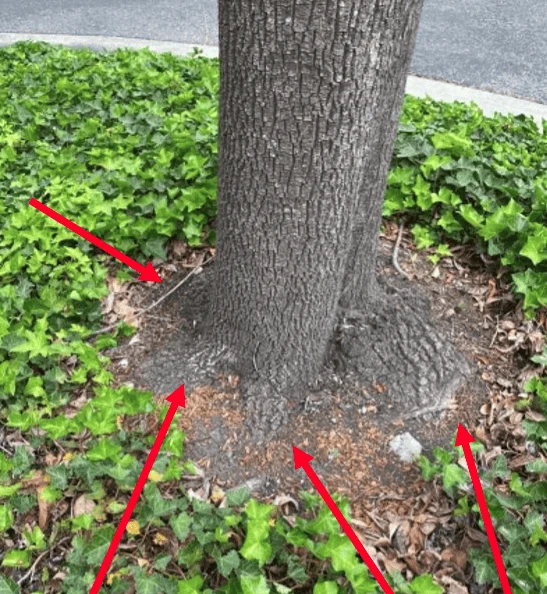
A healthy trunk widens as it enters the soil, the way a neck widens into shoulders. A trunk that goes into the ground straight, like a fence post, is telling you something is either buried or constricted.
Check the root flare around the full circumference of the trunk. A flat or pinched area may indicate pressure from a root below the surface, while deep planting or piled mulch can hide the flare without any girdling root present. An absent flare is a reason to investigate, rather than a diagnosis.
Canopy Thinning, Leaf Scorch, and Branch Dieback
Symptoms in the crown usually arrive late. By the time the canopy changes noticeably, compression at the trunk has often been building for several seasons.
Watch for leaves that come in smaller than normal, foliage that is lighter green or scorched along the margins, premature fall color, early leaf drop, reduced shoot growth, and dieback in twigs or larger branches. University of Maryland Extension’s girdling roots resource notes that decline tends to play out over five to ten years and that damage often shows first in the upper canopy. Picture the crown as a clock face, and the earliest thinning frequently appears between the 10 and 2 positions.
None of that confirms girdling roots by itself. Drought, root disease, construction damage, and soil problems produce overlapping symptoms, so diagnosis requires examining the roots and trunk alongside the tree’s condition and site history.
What Causes Girdling Roots?
Trees do not set out to strangle themselves. Girdling roots often begin with nursery or planting problems, but later changes in soil level, mulch buildup, and restricted growing space can also contribute.
In practice the redirection traces back to the container the tree grew in, the depth it was planted at, or the space its roots had to work with.
Circling Roots in Nursery Containers
Roots that reach the wall of a smooth-sided container have nowhere to go, so they turn and follow the curve. A tree can leave the nursery with a dense spiral of roots holding the shape of the pot.
Planting does not undo that shape. Unless those roots are cut or redirected at installation, they keep growing along the path they learned, and the ones nearest the stem end up pressed against it. This is also why a problem created on planting day may surface fifteen years later on a tree that looked healthy the whole time. The root was small and harmless at first, and the compression only became meaningful as both the root and the trunk gained diameter.
Planting Too Deeply and Burying the Trunk in Mulch
When the flare is buried under soil or mulch, the trunk sits in conditions meant for roots. Trees respond by producing roots up into that buried zone, and those new roots develop close to the stem where there is little room to grow outward.
Burial also hides the evidence. A root that would be obvious at the surface is out of sight under six inches of mulch, so nothing gets caught early. Not every deeply planted tree develops girdling roots, though depth and mulch piled against the trunk raise the odds considerably.
Compacted Soil and Restricted Growing Space
Roots follow the path of least resistance. Compacted soil, a hardpan layer, a curb, a foundation, or the walls of an undersized planting pit all stop outward growth and send roots along whatever open space remains, which is frequently the loose backfill circling the original root ball.
Consider this hypothetical example. A maple goes into a four-foot square cutout in a parking lot, surrounded by compacted base rock on three sides. The roots reach the edges within a few years, turn, and circle back toward the only soft soil available, which is the ring immediately around the trunk. Twelve years on, the canopy thins and the base has lost its flare on the street side. Urban conditions make this outcome more likely, though plenty of trees in tight sites grow normally, so the site alone does not predict the problem.
Can a Tree With Girdling Roots Be Saved?
Sometimes, and the honest answer is that it depends on the individual tree. Early detection may allow corrective treatment before substantial trunk damage develops, although recovery depends on the individual tree. Trees that have lost significant vascular function or developed structural weakness at the base have a much narrower range of options, and treatment may not change the outcome.
Published guidance varies more than most homeowners expect, which itself tells you the decision belongs to someone standing in front of the tree. An assessment weighs several factors together rather than any single measurement.
| Assessment factor | Why it matters |
| Root size relative to trunk diameter | A larger root may support a substantial network of smaller roots, making its removal more consequential |
| Degree of contact and compression | A root resting lightly against the stem is a different situation from one embedded in deformed trunk tissue |
| Existing trunk damage | Flattening, cracking, or dead bark above the root changes what treatment can realistically restore |
| Overall tree condition | A tree already in steep decline has fewer reserves to recover from the disturbance of root work |
| Structural concerns | Compression at the base affects stability, which shifts the decision from health to safety |
| Site and target | What sits under the tree influences how much uncertainty is acceptable |
How Root Size, Trunk Damage, and Tree Condition Affect Treatment
Extension sources disagree here, and reading only the optimistic ones leads to disappointment. Iowa State’s stem girdling roots overview takes the firm position that established girdling roots cannot be corrected, on the grounds that cutting a large root severs the tree from a meaningful share of its root system. Maryland Extension allows that small roots at the surface can be removed, while advising that a large root grafted into the trunk is better left undisturbed.
Both positions come from the same underlying reality. Removing a root relieves compression and costs the tree whatever that root was supplying, and which effect dominates depends on the size of the root, how much of the root system depends on it, and how much function the tree has left.
A small root on an otherwise vigorous tree tips one way. A large root fused into a deformed trunk on a tree that has already lost much of its canopy tips the other. Even after a detailed assessment, an arborist may be unable to predict how much the tree will recover.
When Severe Damage May Make Tree Removal Necessary
Two findings move the conversation from health toward safety. The first is a tree in advanced decline with little living canopy left to support recovery. The second is compression severe enough to compromise the structural integrity of the trunk at ground level, sometimes visible as cracking or a pronounced flattening where the root binds the stem.
Trees in that condition can fail at the base under wind load, which matters a great deal more over a driveway, a play area, or a walkway than in an open field. A tree risk assessment considers the likelihood of failure, what the tree could strike, and the potential consequences to help determine what action is needed and how urgently. Girdling roots do not automatically mean a tree must be removed; that decision depends on its condition, stability, and treatment options.
How Arborists Assess and Treat Girdling Roots
A visit does not begin with a saw. An arborist first examines the tree and site, including visible roots and the trunk base. When important roots are buried, controlled excavation may be needed before a treatment decision can be made.
What follows depends on the root findings together with the tree’s health, structural condition, and site constraints. Selective root removal is one possible outcome. Monitoring without cutting is another. So is a recommendation that addresses something else entirely, if the canopy symptoms turn out to have a different cause. An arborist consultation exists to answer that question before anything is cut.
Exposing the Root Collar to Assess the Problem
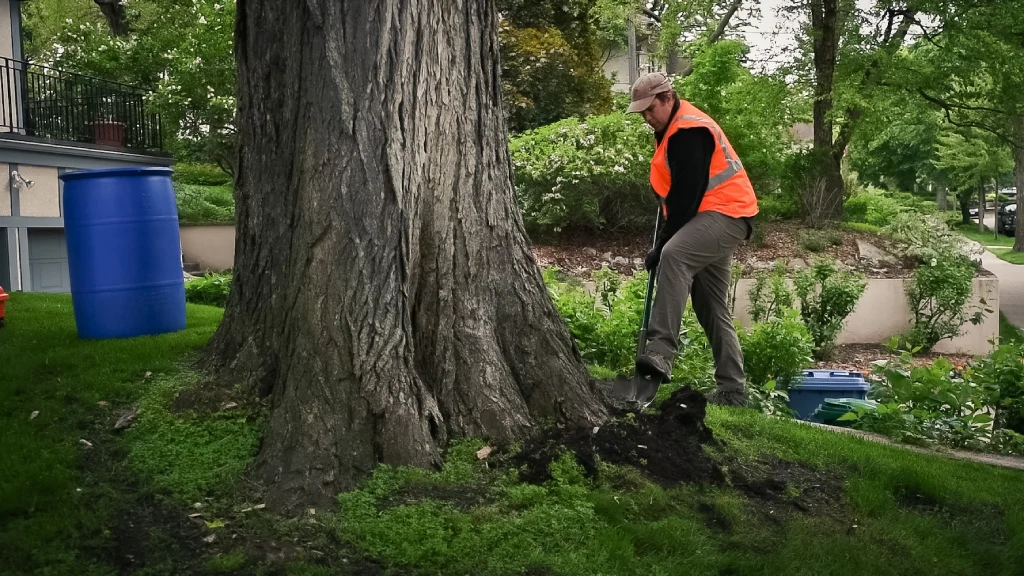
Controlled excavation clears soil and mulch from the trunk base so the root collar and the roots around it become visible. The purpose is diagnostic. An arborist needs to see how many roots are involved, where each one contacts the trunk, how deeply they sit, and what condition the bark underneath is in.
Excavation is done carefully because fine absorbing roots in that zone are easy to damage. Exposing the root collar can reveal problems that were hidden at the surface, though the findings may still require further assessment. A tree with one visible root at the surface may have three below it, or none of consequence.
Selective Root Pruning and Staged Removal
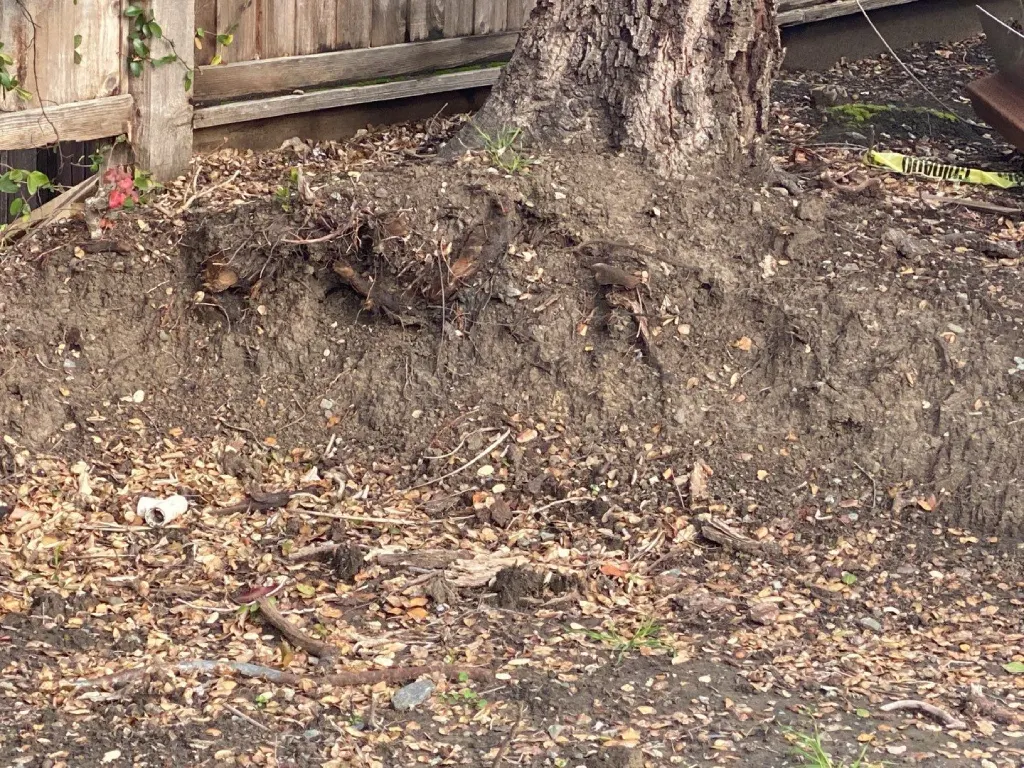
When removal makes sense, the selection is deliberate.An arborist selects roots according to the compression they cause and the root system they support. Where removal is appropriate, a section of the offending root may be removed to interrupt contact and reduce the chance of reconnection, while avoiding injury to the trunk.
Spreading the work across more than one visit is often the safer approach when several roots are involved. Taking everything at once can push a tree that is already under stress into a steeper decline, whereas staging the removals gives it time to compensate between interventions. Intervals are set by the tree’s response rather than a fixed schedule, and there is no standard timeline that applies to every case.
When Cutting a Root Could Cause More Harm
Cutting causes more harm than it relieves when the root being removed is supplying a large share of the tree’s water and nutrients, or when severing it would damage the trunk further. A root that has grafted into deformed trunk tissue often falls into this category, and the Missouri Botanical Garden guidance supports leaving some roots in place when safe removal is not possible.
Root diameter alone cannot establish whether cutting is safe. A root under four inches is not automatically safe to remove. Assessment also considers trunk compression, attachment, the root system it supports, and the tree’s overall condition; some of these factors may remain hidden below ground.
Moving loose mulch and taking photographs are reasonable first steps. Leave deeper soil excavation and cutting roots against the trunk to an arborist. Published methods describing chisel-and-mallet removal apply to small roots whose size and role have already been established at an exposed base, and a cut made in the wrong place cannot be undone.
Caring for Your Tree After Treatment
Aftercare follows the plan set during the visit rather than a standard package. What the tree needs after root work depends on how much was removed, how much stress it was under beforehand, and the conditions at the site.
Two things stay consistent across cases: keeping conditions at the base favorable, and paying attention to what happens next.
Managing Watering and Mulch During Recovery
A tree that has lost root function needs adequate soil moisture without saturation, and the right amount depends on species, soil type, canopy size, and weather. Check moisture several inches down before watering rather than following a fixed schedule. During dry weather, slow watering across the root zone helps moisture soak into the soil instead of running off.
Keep the flare exposed after treatment. Mulch belongs over the root zone at a depth of two to four inches, pulled back from the trunk so the base stays visible and dry. Rebuilding the pile against the trunk recreates the conditions that started the problem.
Supportive care helps a tree hold its ground while it recovers. Water and mulch do not relieve compression, and no fertilizer, soil amendment, or injection removes a girdling root.
Monitoring Recovery and Checking for Recurring Problems
There is no reliable recovery timetable for every tree. Follow-up should track whether canopy condition and growth are stabilizing or declining, and whether further assessment is needed. A stable canopy does not necessarily mean that structural concerns have resolved.
Photograph the trunk base and the full canopy from the same two spots two or three times a year, and keep the dates on the files. Watch for new roots developing near the stem, since circling growth can recur when site conditions stay the same. Note canopy density, leaf size, new shoot growth, and whether dieback is spreading or holding.
Follow-up timing should come from the plan your arborist set, and a staged treatment interval is a treatment schedule rather than a promise about recovery time.
How to Prevent Girdling Roots
Inspecting nursery stock and planting carefully can reduce the risk of girdling roots and avoid difficult treatment decisions later. Focus on three stages.
- Before you buy: clear the top of the root ball and look for roots spiraling around the stem
- At planting: set the flare at or slightly above grade and keep mulch off the trunk
- As the tree grows: check the base regularly and after changes to mulch or soil levels
Inspect Nursery Roots and Correct Circling Growth Before Planting
Before purchase, pull soil back from the top of the root ball and look at the root structure near the stem. Roots should radiate outward. A dense spiral following the shape of the container is a warning, and a tree with heavily circling roots at the trunk is worth passing over.
Teasing apart or cutting small circling roots at planting is reasonable and normal practice. Heavy root correction on a large or expensive specimen is a different matter, and so is a root ball where the circling is severe enough to raise the question of whether the tree should go in at all. If you are arranging professional tree planting, ask how the crew will assess circling roots and confirm the planting depth before installation.
Plant at the Correct Depth and Keep Mulch Away From the Trunk
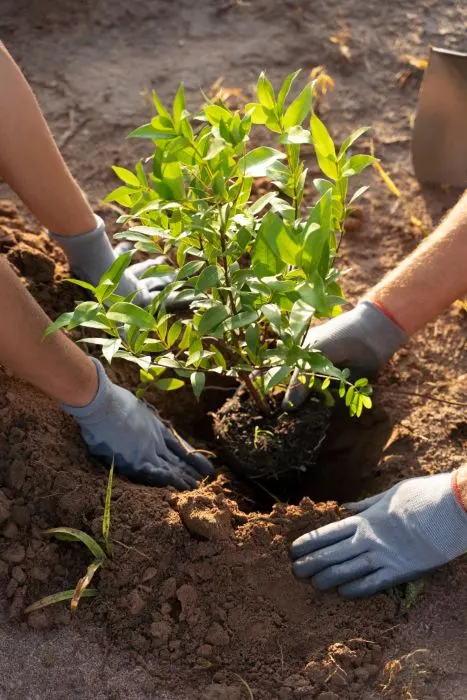
The principle is short. The flare sits at or slightly above the surrounding grade, and the trunk stays clear of soil and mulch for the life of the tree. These practices reduce avoidable risks, but existing circling roots also need attention before planting. To establish the correct planting depth, locate the actual flare within the root ball and measure from there to the bottom of the ball before digging the hole.
When refreshing mulch, check the existing layer first so repeated applications do not gradually bury the flare.
Check the Tree Base as Your Tree Grows
An annual look at the trunk base is the habit that catches this problem while it is still small. Clear mulch back, check the flare around the full circumference, and note any root that touches or runs along the trunk.
Early detection can make treatment less disruptive, but root growth and the onset of damage vary. Continue checking as the tree matures, because a problem may become apparent long after planting. Mark the check on a calendar in early spring, when the base is easy to see.
Frequently Asked Questions About Girdling Roots
Which Tree Species Are Most Prone to Girdling Roots?
Maples, lindens, and elms appear most often in extension reports, along with beech, pines, and zelkovas. Any species can develop girdling roots under the wrong planting conditions.
What Affects the Cost of Girdling Root Treatment?
Cost depends on assessment scope, access around the trunk, how many roots are involved, how deeply they sit, and whether follow-up visits or staged work are recommended.
What Is the Best Time of Year to Treat Girdling Roots?
Timing depends on tree condition and local climate, and work is often scheduled outside periods of heat or drought stress. Assessment itself should not wait for a season.
Can Girdling Roots Spread From One Tree to Another?
No. Girdling roots are not contagious. Several trees on one property may develop them independently because they were grown, planted, or mulched the same way.
What Information Should I Provide When Requesting a Girdling Root Assessment?
Send photos of the trunk base and the whole canopy, note when symptoms started, and share planting history plus any recent landscaping, irrigation, or grading changes.
Get Help Assessing Your Tree With A Plus Tree
A root against the trunk, a base with no flare, a canopy thinning from the top down: any one of those is worth a closer look, and none of them settles the question on its own. An arborist can examine those signs, expose buried roots if needed, and assess whether girdling is contributing to the problem.
Our ISA Certified Arborists assess the base, identify what is contributing to the decline, and give you a recommendation based on the condition of your tree, which may be selective treatment, monitoring, or something else entirely. Contact A Plus Tree to discuss your concerns and arrange an assessment.
Get a Free Tree Assessment — No Obligation
Tell us about your tree. One of our ISA Certified Arborists will review your situation and get back to you within 24 hours.