
A tree that looked healthy in early summer can look scorched and half bare after one stretch of triple-digit afternoons. Brown leaf edges, drooping branches, and a thinner canopy show up fast, and they are unsettling on a tree you have watched grow for years.
Many trees can recover from heat stress, particularly when damage is limited and growing conditions improve. Whether yours will depends on how severe the exposure was, how long it lasted, the species, and what condition the roots were in beforehand.
Reading the symptoms correctly, supporting the root zone, and watching how the tree responds over the following weeks will tell you far more than any single afternoon of wilted leaves. Some situations warrant professional tree health care rather than homeowner care alone, and the signs that separate the two are easy to learn.
What Determines Whether a Heat-Stressed Tree Can Recover?
Trees handle short heat events far better than long ones, and five factors decide most outcomes:
- Severity and duration of the heat. A few scorching afternoons ask much less of a tree than three straight weeks above 100 degrees.
- Species and exposure. Some trees suit the spot they are growing in, others struggle every summer in it.
- Health before the heat wave. A tree already dealing with pests, disease, or old wounds has less in reserve.
- Root condition. Root damage, compacted soil, and waterlogging can limit water uptake, so adding water may not resolve the underlying problem.
- Moisture in the weeks that follow. Recovery stalls if the soil stays dry once the heat breaks.
A healthy mature oak that wilts through a three-day heat wave has a very different outlook than a young maple that spent three weeks in dry, compacted soil.
Heat stress starts with water movement. Trees pull water up from the roots and release it through pores in the leaves, and evaporation from that moisture cools the canopy, much the way sweating cools a person on a hot day. The Arbor Day Foundation’s explanation of heat and transpiration compares the process to sweating and notes that long stretches of extreme heat can push water loss past what the tree can replace. Heat stress and drought stress overlap, but they are not identical. A tree can be well watered and still struggle when air temperatures stay high enough that the canopy loses moisture faster than the roots can supply it.
Root condition helps explain why watering alone may not restore a tree’s health. Trenching, compaction, and saturated soil can limit the roots’ ability to supply the canopy. Newly planted trees are vulnerable for a related reason, since their root systems have not yet spread into the surrounding soil, and the same is true of trees still working through tree transplant shock from a recent move.
Not sure if your tree needs professional attention?
A Plus Tree’s ISA Certified Arborists serve homeowners across the West Coast. A free assessment takes 15 minutes and gives you a clear answer.
How to Recognize Heat Stress in Your Tree
Heat shows up in the canopy first, and the visible signs are fairly consistent across species. What appearance alone cannot do is confirm the cause, since several unrelated problems produce similar-looking leaves. Start by describing exactly what you see, then work through the possible causes before deciding on treatment.
Wilting, Curling, and Scorched Leaves
Leaves under heat stress often droop or curl inward, which reduces the surface area exposed to the sun. Wilting that appears in the afternoon and eases by the next morning is common during extreme heat, and it also counts as an early signal that soil moisture is running short. Leaves that stay limp overnight say the tree is not catching up at all.
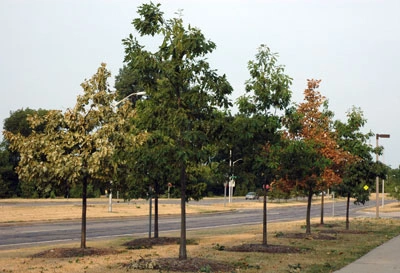
Scorch looks different from wilting. Dry brown tissue develops along leaf margins and tips, sometimes spreading inward between the veins, and the affected tissue feels papery rather than soft. Firmness can return to a wilted leaf. Scorched tissue is dead and will not turn green again. UC IPM’s leaf scorch guidance attributes the same symptom to a range of environmental factors, salt burn, and mineral toxicity that restrict water movement into leaves, so browning edges alone do not prove heat was responsible.
Early Leaf Drop and Canopy Thinning
Premature leaf loss can be alarming, but on its own it does not mean the tree is dying. Shedding leaves is one way a stressed tree reduces its water demand, in the same way you might close half the windows in a house to hold onto cool air. Texas Trees Foundation’s summary of heat stress symptoms lists leaf drop and even summer dormancy among the responses some species show during extreme heat.
The pattern matters more than the event. Limited interior leaf drop during a heat wave can be a stress response, particularly if the remaining canopy stays stable. Continued thinning or loss concentrated on one side warrants closer assessment rather than an assumption that heat is the only cause. Note how much of the canopy is affected and whether the loss stops once temperatures drop.
Could Drought, Overwatering, or Root Problems Be Involved?
Yes, and often more than one of them at the same time. Wilting, browning, and leaf drop are general distress signals rather than a diagnosis, which is why two trees with identical-looking canopies can need opposite responses.
Wet soil is the trap worth knowing about. Saturated soil pushes oxygen out of the pore spaces roots depend on, so a tree standing in damp ground droops much like one in bone-dry ground. The signs of overwatering trees can include canopy symptoms as well as persistently wet soil, so check below the surface before assuming a wilted tree needs more water.
Run through recent history before you act. Ask whether the tree was planted in the last two or three years, whether an irrigation timer changed or a head stopped working, whether drainage has altered, and whether anyone has dug, trenched, or parked near the root zone. A yes to any of those belongs in the picture alongside the heat.
How to Help a Heat-Stressed Tree Recover
The goal of recovery care is narrow: give the roots workable conditions and stop adding demands the tree cannot meet. Nothing you apply will repair damaged leaf tissue, so the work is about supporting new growth rather than rescuing what has already browned. Work through the recovery steps in order, starting with the question of whether the tree needs water at all.
Check Soil Moisture Before Adding Water
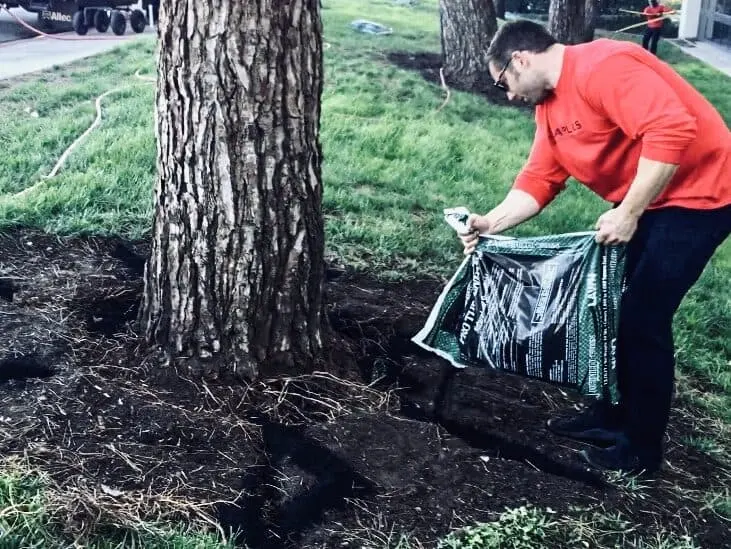
Check soil moisture several inches below the surface at a few points under the canopy. For newly planted trees, check both the original root ball and the surrounding soil. Use a soil-sampling probe gently and reposition it if you meet resistance; do not force it through roots. Inspect the soil itself, since resistance can also indicate compaction or an obstruction. Dry soil indicates a need for watering, while soil that remains moist generally does not need more yet.
Persistently soggy soil calls for the opposite response. If water pools, smells sour, or stays wet for days after irrigation, adding more will deepen the problem rather than solve it. Hold off on watering, look at drainage and irrigation settings, and treat the root zone as the issue rather than the heat.
Water Slowly Across the Root Zone
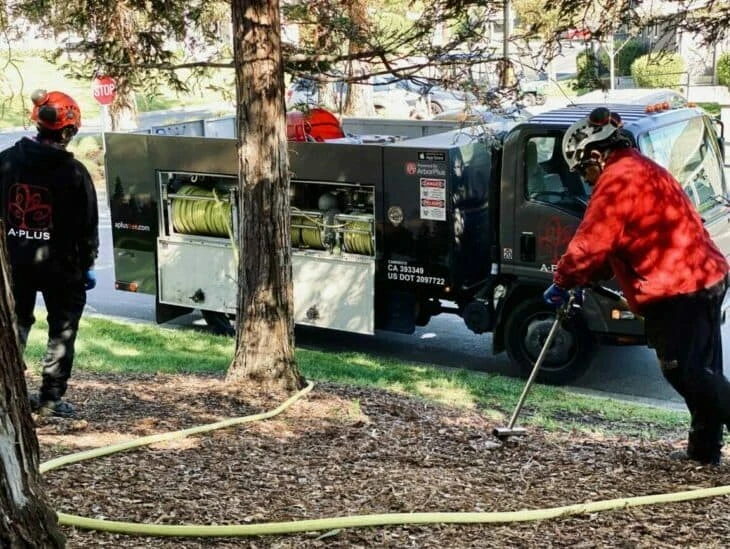
Slow application is what separates useful watering from wasted water. A hose at low flow, a soaker hose, or a drip line gives soil time to absorb moisture instead of shedding it across a crusted surface. Water the area under the canopy and slightly beyond it, since the roots that take up water extend well past the trunk. Check your work by probing the soil again an hour after you finish to see whether moisture actually reached root depth.
No single schedule fits every tree. Species, soil texture, drainage, weather, and how long the tree has been in the ground all change the answer, which is why a number that suits a valley oak in clay will be wrong for a young birch in sand. Newly planted trees need particular attention, because water often runs around the original root ball rather than into it. Large trees, portfolios of trees, and sites where irrigation cannot reach the root zone are good candidates for supplemental deep watering, which places water below the surface where the absorbing roots are.
Apply Mulch Without Covering the Trunk Flare
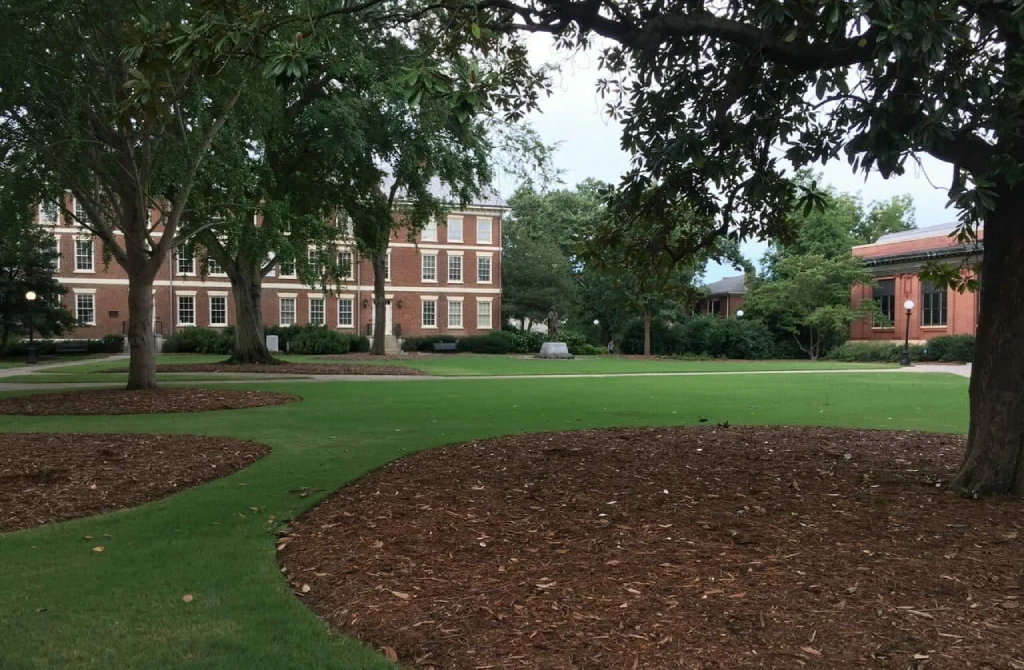
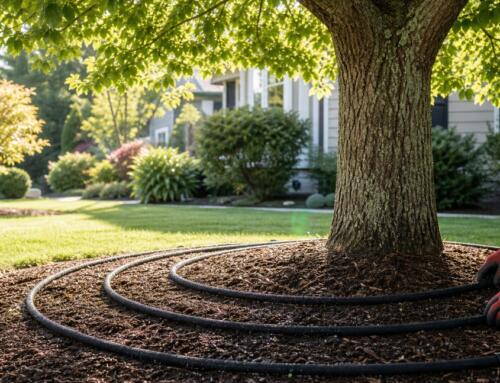
Mulch does quiet, steady work during a heat wave. A layer of wood chips slows evaporation, moderates soil temperature, and keeps mowers and trimmers away from the base. Arbor Day Foundation guidance puts the layer at 2 to 4 inches, spread out toward the drip line, which reduces evaporation and keeps the soil from absorbing and radiating excess heat.
Application decides whether mulch helps or hurts, and three points cover it:
- Measure what is already there. Many trees carry several inches of old mulch, and topping it up builds a layer thick enough to shed water instead of letting it through.
- Keep the trunk flare clear. Pull mulch back several inches from the base, where the trunk widens into the roots, so that area stays visible and dry.
- Spread wide rather than deep. A broad ring reaching toward the drip line covers far more of the root zone than a mound piled at the trunk.
Plenty of homeowners hold back on mulch over worries about soil acidity, termites, or rodents, and those myths about wood chip mulch fall apart once the layer stays at a sensible depth and off the bark.
Avoid Unnecessary Fertilizing and Heavy Pruning During Recovery
Fertilizer is not a heat-stress remedy. Nutrients do not fix a water problem, and pushing new growth on a tree that cannot support its existing canopy adds to the demand rather than easing it. Cooler weather arriving is not by itself a reason to feed. Soil testing and a documented deficiency are, and that assessment belongs after the tree has stabilized.
Pruning splits into two categories. Removing live limbs to tidy the canopy costs the tree foliage it needs for energy, so elective reduction can wait for a healthy season. Dead, broken, hanging, or cracked branches are a different matter entirely. A limb over a driveway, walkway, or play area is a safety issue on its own schedule, and waiting for the tree to recover before assessing it is not the safe choice.
How Long Does It Take for a Tree to Recover From Heat Stress?
There is no single recovery period. Wilting may ease after temperatures fall and suitable soil moisture is restored, while replacement foliage depends on species, season, and damage. More extensive recovery may take multiple growing seasons, and some trees will not recover. What helps is knowing which changes to expect first and when each one can fairly be judged.
Early Improvement and Recovery Into the Next Growing Season
The first signs of progress are subtle. Less afternoon wilting, leaves holding their firmness later into the day, and no fresh browning all arrive early, because they reflect water balance rather than new growth. Fuller canopy recovery is a longer story. Damaged leaves do not repair themselves, so the canopy you see in August is largely the canopy you have until new foliage arrives.
Replacement growth depends on the species and the timing. Some trees push a flush of new leaves once heat breaks, others hold their buds until spring, and a tree that lost a large share of its canopy may need more than one season to rebuild. Severe cases carry genuine uncertainty, and honest assessment often means waiting for the next growing season to see what leafs out.
Reading progress accurately comes down to separating what an observation shows from what it cannot show.
| What you observe | What it may mean | What it does not establish |
| Wilting in the afternoon, recovery by morning | The tree is managing daily heat load | That soil moisture is adequate over the longer term |
| Brown leaf margins that stop spreading | Visible leaf damage may be stabilizing | That the underlying stress has ended or the roots are undamaged |
| New leaves after temperatures drop | The tree retained enough energy to respond | That the whole canopy will return this season |
| Branches remain bare after the tree’s normal leaf-out period | Delayed growth or branch dieback warrants assessment | That the entire tree has died |
How to Track Improvement or Continued Decline
Monitoring beats memory. Photograph the tree from the same two or three positions every week, in similar light, and keep the images together so you can compare the canopy rather than trusting your recollection of how it looked a month ago. Alongside the photos, note soil moisture readings, whether affected areas are holding steady or expanding, and how quickly wilted leaves recover overnight.
Here is what that looks like in practice. Picture two maples in the same yard, a hypothetical case but a familiar one, both looking dreadful at 4 p.m. in mid-July. Weekly photos of the first show the same amount of brown leaf margin every week, no newly affected branches, and firm leaves each morning. That tree looks poor and is holding steady. Photos of the second show browning reaching further into each leaf and spreading to branches that were clean in week one, which is the pattern that earns a professional look. Neither conclusion was available on day one.
When Does a Heat-Stressed Tree Need an Arborist?
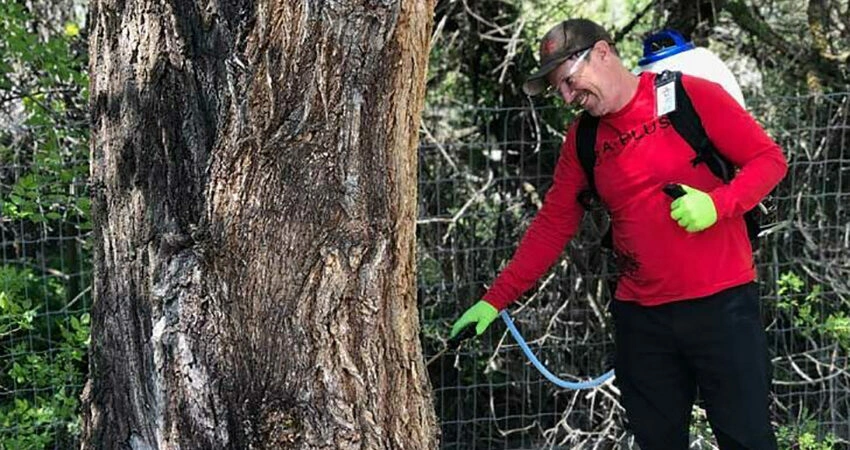
Three situations call for professional eyes: symptoms that keep worsening despite appropriate care, uncertainty about what is actually causing the decline, and anything structural on the tree. An arborist can also identify contributing conditions you cannot see from the ground, such as root damage, soil compaction, or a pest problem that moved in while the tree was weakened. When a board or property manager needs documented findings to guide tree-care decisions, arborist consulting and formal assessments can provide that support.
Persistent Wilting, Spreading Dieback, or Branch Hazards
Some observations move a tree from watch to assess. Consider professional evaluation when you see any of the following:
- Wilting that persists or worsens despite suitable soil moisture and cooler conditions
- Dieback expanding into branches that were healthy earlier in the season
- Cracks, cavities, peeling bark, or mushrooms at the base or on major limbs
- Dead or hanging limbs above a walkway, driveway, parking area, or play space
- Sudden decline in a tree near recent construction, trenching, or grade changes
Structural concerns do not wait for a recovery timeline. A cracked limb is a hazard in week two exactly as it is in week twelve, and it should be assessed on its own terms rather than folded into the question of whether the tree will pull through.
What Twig and Bud Checks Can and Cannot Tell You
Scratching a small patch of bark on a low, easy-to-reach twig with a fingernail shows you something real. Green, moist tissue indicates living tissue at the spot checked. Brown, dry tissue suggests localized dieback but does not establish the condition of the entire twig or tree. Keep the check to twigs you can reach from the ground, and leave the trunk alone, since scraping bark on the stem creates a wound without giving you better information.
The limits are worth stating plainly. One living twig tells you about one twig, not about the roots, the trunk, or the branches 20 feet up. One dead twig tells you as little in the other direction, since trees shed small branches routinely. Consistent results across several twigs in different parts of the canopy carry more weight, and a whole-tree verdict needs an arborist who can assess the root zone and structure together.
How to Reduce Heat Stress Before the Next Heat Wave
The work that protects trees through the next heat event happens before it arrives. Walk your irrigation while the system runs and look for heads spraying pavement, emitters clogged shut, or zones that miss the trees entirely, since coverage tends to drift over years. Identify which trees carry the most risk, usually the recently planted ones, the species poorly suited to a hot exposure, and anything in a reflected-heat location beside asphalt or a south-facing wall. Those get checked first when temperatures climb.
Protecting the root zone through the rest of the year also pays off in July. Compaction from parking or storage, trenching for utilities, and grade changes all reduce a tree’s capacity to take up water long before a heat wave exposes the problem. Maintaining mulch correctly and keeping traffic off the root zone help protect the roots before summer heat adds further stress.
Frequently Asked Questions About Tree Heat Stress
Should I Remove Scorched Leaves From My Tree?
Removing a few unsightly leaves is harmless, but leave partially green ones in place. They still produce energy the tree needs, and stripping the canopy adds stress.
Can Moving a Potted Tree Into Shade Help It Recover From Heat Stress?
Yes. Afternoon shade lowers the heat load on container roots, which warm quickly. Move it gradually to a bright, sheltered spot rather than indoors into deep shade.
Can a Fruit Tree Recover After Dropping Unripe Fruit During a Heat Wave?
Often, yes. Shedding fruit is a stress response that protects the tree’s water supply. Losing this season’s crop does not mean the tree itself is dying.
Support Your Tree’s Recovery With A Plus Tree
A scorched canopy does not automatically mean a tree is beyond recovery. Checking soil moisture, maintaining mulch correctly, and monitoring changes can support recovery and help you recognize when professional assessment is needed.
When symptoms keep spreading, the cause is unclear, or a branch looks unsafe, an arborist can assess the problem and recommend care, further investigation, or monitoring. Our ISA Certified Arborists walk the property, evaluate what is driving the decline, and recommend the care that fits, so request a tree assessment if your trees came through the heat looking rough.
Get a Free Tree Assessment — No Obligation
Tell us about your tree. One of our ISA Certified Arborists will review your situation and get back to you within 24 hours.