
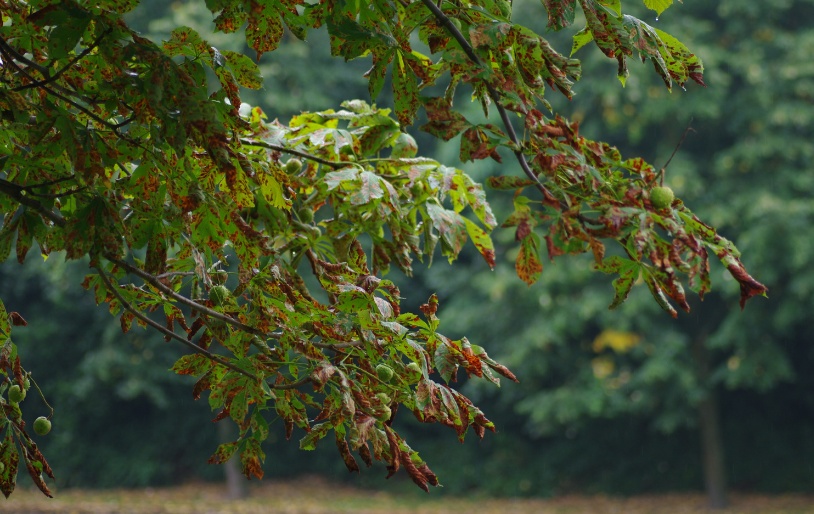
Thrips damage tends to announce itself weeks after the fact. You pass a hedge you have looked at all summer, and the foliage has gone dull silver in patches, with tiny black specks scattered across the surface and a few terminals folded in on themselves. The insect responsible is often long gone.
That delay is why so many trees and shrubs get sprayed for something that already moved on. Healthy woody plants tolerate a surprising amount of thrips feeding without lasting harm. Gall-forming species, and infestations that return to the same plant year after year, deserve a closer look and sometimes a treatment plan from a professional who handles tree pest and disease management across a property.
Quick Answer
Thrips damage is scarring left by tiny insects that scrape open leaf, flower, and bud tissue and feed on what leaks out. It appears as silvery or bronze patches, black frass specks, and distorted new growth. Most damage on established landscape plants is cosmetic.
Thrips Damage at a Glance
| Symptom | Where it appears | Supporting thrips clue |
| Silvery or bronze patches | Upper leaf surfaces, often near veins | Black frass specks within or beside the discolored area |
| Pale flecking and fine streaks | Newest fully expanded leaves | Feeding marks concentrated along the midrib and leaf edges |
| Curled or folded terminals | Tips of new growth | Insects visible inside the fold when it is opened |
| Tight, pod-like galls | Terminal growth on Myoporum and Ficus | Multiple life stages sheltered inside the sealed tissue |
| Streaked petals, aborted buds | Flowers and flower buds | Insects moving across white paper after the branch is tapped |
| Rough surface scars on fruit | Skin of developing fruit | Scarring that dates back to bloom, not to the current week |
What Does Thrips Damage Look Like?
Most people notice the damaged tissue well before they notice the insect. An adult thrips sits comfortably on the head of a pin, so the visible evidence arrives first: a change in color, a change in texture, or new growth that came in the wrong shape. Reading those marks tells you which part of the plant was under attack and roughly how long ago.
What Are the First Signs of Thrips?
The earliest signs of thrips are easy to miss, because nothing looks obviously wrong yet. On the newest leaves, look for:
- Faint pale flecks no larger than a grain of salt
- Short silvery streaks a few millimeters long, often following the midrib
- Black specks with a wet, varnished look, which is thrips frass and not soil or soot
- New growth that opened slightly puckered along one edge
Nothing at this stage is dramatic, and nothing needs treating.
Thrips Damage on Leaves: Silvering, Stippling, and Black Specks
Thrips feed by rasping open the surface cells of a leaf and drinking the contents. Think of it like scraping a thin layer of paint off a wall: what remains is a dry, empty, light-catching surface. Air fills the emptied cells, and the tissue reflects light differently, which is why thrips damage on leaves reads as silver rather than yellow.
As feeding continues, small flecks merge into broad silvered patches, then take on a bronze or brown cast as the dead tissue ages. Frass darkens with the leaf and grows harder to spot on older foliage.
Curled, Distorted, or Gall-Like New Growth
Expanding leaves are soft, and feeding on one side of a leaf while it is still opening stunts that side while the other keeps growing. The leaf then unfolds crooked, cupped, or twisted. Ordinary distortion stays loose and open, and you can flatten the leaf between your fingers.
Gall-forming species produce something different. The leaf folds tightly along its length and seals into a pod or purse shape that will not open without tearing. Inside, the insects are sheltered from weather, predators, and most sprays.
Thrips Damage to Flowers, Buds, and Fruit
Flowers show the damage fastest because petal tissue is thin and short-lived. Feeding produces pale streaks and brown edges, and blooms fade several days earlier than they should. Buds fed on before they open may brown at the tip, drop early, or open lopsided.
Developing fruit takes a different injury. Feeding at bloom leaves rough, corky, silvered patches on the skin that expand as the fruit grows, so a small mark in April becomes a broad scar by midsummer.
Not sure if your tree needs professional attention?
A Plus Tree’s ISA Certified Arborists serve homeowners across the West Coast. A free assessment takes 15 minutes and gives you a clear answer.
Don’t Treat the Scar: Identify and Confirm Active Thrips
Is the culprit actually a thrips? And is it still feeding on the plant today? Both questions have to be settled before anyone reaches for a treatment, and the second one catches most people out.
Damaged tissue never heals. A silvered leaf stays silvered for the rest of its life, so the scars in front of you record something that happened, not evidence that it is still happening. The University of California’s statewide IPM program gives the same guidance: confirm that pest thrips are present before deciding to act.
What Do Thrips Themselves Look Like?
Adult thrips are tiny and needle-thin, usually under a twentieth of an inch long, which is roughly the thickness of a dime. Color runs from reddish yellow through tan and brown to nearly black depending on species and life stage, and populations active in the cold months tend to be darker. Their wings are narrow strips fringed with long hairs, difficult to see without magnification.
Species identification is a laboratory matter. Two thrips that look identical through a hand lens may have entirely different host plants and treatment considerations.
Where Thrips Hide on Trees and Plants
Point your hand lens at the sheltered places, not at the obvious damage. Leaf undersides and the grooves alongside major veins hold feeding populations, and tender terminals, unopened buds, and flower interiors are all worth checking. Immature stages often sit deep in a leaf fold or inside a gall where nothing reaches them.
Some species drop to soil or leaf litter to pupate, so a plant with no visible insects may still have a generation developing underneath it.
The Thrips Life Cycle and When Damage Shows Up
Egg laying varies by species. The western flower thrips life cycle starts with eggs laid inside leaf and bud tissue, while greenhouse thrips lays them openly on foliage and the gall-formers on Myoporum and Ficus lay inside the folds their own feeding created. Larvae hatch and feed on the same tender growth, and many species then drop to pupate in soil or leaf litter before returning as adults.
Only the adults and the first two immature stages feed. Several generations pass through a single summer, so eggs, larvae, and adults are often present on one plant at once. Feeding concentrates on soft new growth, and damage becomes obvious after that tissue expands and hardens. Spring flush and warm, dry stretches are the general triggers, while cold, wet weather during bloom holds damage down. That overlap is one reason beneficial insects that prey on thrips and other pests matter: they work against pest populations across the season rather than at a single moment.
How to Check for Thrips With White Paper and a Hand Lens
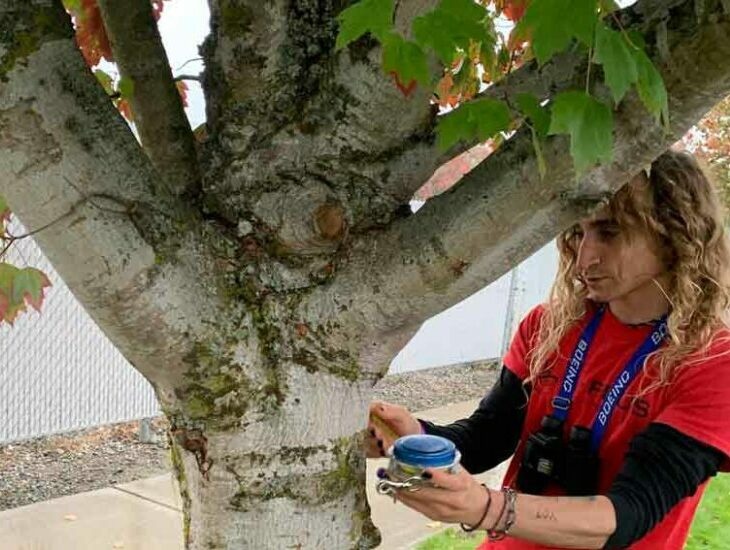
The field check takes about a minute and settles the question better than any photograph. Hold a sheet of white paper or a white clipboard under the growth you are worried about, then:
- Tap or shake the branch firmly three or four times.
- Watch the paper closely for ten seconds. Dislodged thrips move quickly and look like animated slivers.
- Bring a hand lens to the paper and confirm the narrow body and fringed wings.
- Check nearby damaged tissue and frass under the same magnification.
Repeat on two or three parts of the plant before concluding that nothing is there.
Thrips Damage vs. Spider Mites, Aphids, Leafhoppers, and Plant Stress
Several unrelated problems produce pale, stippled, or distorted foliage, and telling them apart saves an unnecessary application. A few reliable details separate thrips from the look-alikes that come up most often on landscape plants. If fine webbing shows up on leaf undersides or in branch crotches, compare the pattern with common early signs of spider mites before treating for thrips.
| Damage pattern | Thrips | Common look-alike | Best distinguishing clue |
| Silvered or stippled leaves | Silvering with black varnish-like frass, no webbing | Spider mites | Fine webbing on leaf undersides and in branch crotches |
| Distorted new growth | Distortion plus feeding scars on the same tissue | Aphids | Sticky honeydew, sooty mold, and visible clusters of soft-bodied insects |
| Pale flecking on leaves | Irregular flecking concentrated on newest growth | Leafhoppers | White cast skins on leaf undersides and insects that hop when disturbed |
| Yellowing between veins | Patchy discoloration that varies noticeably from leaf to leaf | Nutrient deficiency | Symmetrical pattern repeated the same way on every leaf |
| Twisted, strap-like growth | Damage limited to tissue that was tender when fed on | Herbicide exposure | Whole-plant distortion, often on several unrelated species nearby |
| Browning leaf margins | Scarring that starts as discrete feeding marks on new growth | Sun or wind injury | Damage confined to the exposed side of the plant, regardless of leaf age |
Thrips on Plants: Which Trees and Shrubs Are Most Affected?
Susceptibility follows the thrips species more than the plant. Many thrips use a narrow range of hosts, so the same shrub gets chewed up on one property and stays untouched two streets over. A few species break that rule: western flower thrips feeds on hundreds of plants and turns up almost anywhere.
Across California and the Pacific Northwest, the hosts that come up most often on service calls are Myoporum, Ficus, lilac, privet, azalea, rhododendron, and rose. No tree or shrub should be treated as automatically at risk.
California Thrips Damage on Myoporum and Ficus
Two California problems account for most of the serious cases. Myoporum thrips attacks susceptible Myoporum species, chiefly Myoporum laetum and M. pacificum, and it matters along the coast from San Diego through the San Francisco area, where those plants are used heavily as screens and slope cover. Damage goes past cosmetic on this host. Persistent feeding on terminal growth stunts the plant and kills well-established specimens, so UC IPM’s guidance on myoporum thrips puts the emphasis on prevention for valuable plantings.
Cuban laurel thrips and related gall-formers work on susceptible Ficus, folding terminal leaves into sealed pods from midsummer through fall and leaving dark scarring behind. Greenhouse and western flower thrips turn up on a wider assortment of ornamentals, usually with silvering and flower streaking rather than galls.
A property manager in the East Bay calls about a 200-foot Myoporum hedge screening a parking area, where the top third has gone gray and lumpy over one season. The galls hold several generations, and a single spray would reach almost none of the insects sealed inside them. At that scale, professional arborist consulting can help assess the site and clarify the best management path.
Thrips on Woody Ornamentals in the Pacific Northwest
Around Seattle, Tacoma, and Portland the cast changes. Lilac and privet are the hosts homeowners ask about most, usually reporting foliage that lost its color through July and looks dusty gray from a distance. Flowering ornamentals and backyard fruit trees also take feeding damage in warm, dry stretches.
Severity varies enormously by plant and site. The Pacific Northwest Insect Management Handbook’s entry on landscape thrips is the reference regional professionals use for host and species specifics.
| Region | Representative host | Typical damage | Important qualification |
| Coastal California | Myoporum | Folded, galled terminal growth | Susceptible species decline and sometimes die under repeated damage |
| California | Ficus | Folded leaves and dark scarring | Damage is frequently aesthetic but persistent |
| California and PNW | Mixed ornamentals | Silvering, stippling, flower streaking | Host range depends on species |
| Pacific Northwest | Lilac and privet | Silvered foliage and dark frass | Confirm active thrips before treating |
Is Thrips Damage Cosmetic, or Is the Plant Declining?
Knowing the marks are thrips feeding leads to a harder question: does any of it matter to the plant? An established tree carries far more leaf surface than it needs, so losing some of that capacity registers as an appearance problem, not a health problem. Susceptible Myoporum is the exception worth knowing in California, where repeated terminal galling kills mature plants. For everything else, the answer depends on how much tissue was affected, how often it happens, and what else the plant is dealing with.
When Monitoring Beats Treating
A vigorous woody plant with scattered silvering on last season’s growth needs observation, nothing more. Check the newest growth every two weeks through spring and early summer, and note whether fresh damage appears on tissue that emerged after you first saw the problem. Clean new leaves mean the population moved on or dropped low enough to ignore.
Treating at that point spends money, disrupts predators, and leaves the existing scars exactly as they were.
Can Trees and Shrubs Recover From Thrips Damage?
Recovery works in one direction only. Damaged tissue stays damaged for the life of that leaf, so a silvered leaf will not green up and a scarred fruit will not smooth over. What the plant does is grow past the problem: once feeding pressure drops, the next flush comes in normal.
For most shrubs and small trees, one clean growing season replaces enough foliage that the damage stops being noticeable. Evergreens holding leaves for several years take longer.
Conditions That Make Thrips Damage Consequential
The picture changes when feeding repeats or combines with other stress. Watch for damage on every new flush instead of a single one, extensive gall formation across most terminals, stunted or dying tips, premature leaf drop, and a general loss of vigor. Damage spread evenly through a uniform planting, such as a long hedge or a row of street trees, also raises the stakes, because the whole feature declines at once.
Thrips feeding alongside drought, compacted soil, poor irrigation, or another pest is what turns a cosmetic issue into a decline.
How to Get Rid of Thrips on Trees and Outdoor Plants
Control decisions start from a live infestation, not a scarred leaf. Once you have confirmed insects on the paper and fresh marks on new growth, the response works as a ladder, starting with the least disruptive option that fits the situation and moving up only if the damage justifies it. If localized pruning is part of that ladder, the goal is to prune without causing unnecessary damage, not strip away healthy foliage along with the infested growth.
| Control option | Best suited to | Limitation or caution |
| Monitoring | Old or limited cosmetic damage | Requires continued inspection of new growth |
| Targeted pruning | Localized infested terminals or galls | Overpruning can stress the plant |
| Water and plant care | Exposed thrips and stressed plants | May not control protected populations |
| Natural enemies | Low to moderate landscape populations | Broad-spectrum pesticides disrupt them |
| Professional treatment | Confirmed, ongoing, consequential damage | Product, method, and timing must fit the pest and plant |
Step 1: Prune and Dispose of Infested Growth When Appropriate
Removing galled or heavily infested terminals takes the sheltered life stages out of the landscape along with the tissue. Cut back to healthy wood on the affected shoots, bag the material, and keep it out of the compost pile.
Precision matters. Shearing a whole hedge to reach damage on the outer few inches strips an enormous amount of healthy leaf area and pushes out a flush of tender new growth, which is the tissue thrips prefer.
Step 2: Reduce Plant Stress Without Overfertilizing
A plant with adequate water and reasonable soil handles feeding damage far better than one already under strain. Water deeply and less often so moisture reaches the full root zone, and check several inches down instead of watering on a fixed schedule. Rinsing dust off foliage helps near unpaved drives, where dust suppresses the small predators that keep thrips in check. A morning hosing also knocks exposed thrips off the plant.
Hold back on nitrogen. Heavy feeding pushes out soft, fast growth that gives thrips exactly what they want.
Step 3: Protect Predators and Other Beneficial Insects
Landscapes carry a working population of thrips predators already: predatory thrips, minute pirate bugs, lacewing larvae, and predatory mites. Broad-spectrum insecticides applied for something else wipe out that population and leave the plant more vulnerable to the next generation than it was before.
Buying and releasing beneficials works reliably in greenhouses. Outdoors, released insects disperse, so protecting what is already there produces better results.
Step 4: Match Any Treatment to the Thrips, Plant, and Site
No single product answers every thrips problem. The variables that decide the right approach include the species involved, whether the insects feed in the open or inside sealed galls, the size and species of the plant, which life stage is active, whether the plant is in bloom and drawing pollinators, the product label, local regulations, and the access and drift risk at the site. EPA guidance on pesticide labels explains why those directions govern where, how, how much, and how often a pesticide may be used.
Gall-formers show why the list matters. A contact spray reaches the outside of a folded leaf and none of the insects inside it, so the method has to suit the hiding place. Any product recommendation should come from a qualified professional and be verified against the current label. When thrips pressure is part of a broader decline, a tree health care plan can address pest pressure alongside soil, irrigation, and other sources of plant stress.
Step 5: Choose Better-Adapted Plants When Damage Returns Every Year
Some plantings never stop having the problem. A susceptible species on a site that favors the pest will be damaged again next spring and the spring after, and repeat treatment becomes a permanent line item that resolves nothing.
Replacing that planting with a species the local thrips does not use ends the cycle. Phasing the work over two or three seasons keeps the screen or streetscape intact while the change happens.
Are Thrips Hard to Get Rid Of?
Yes, in the sense that one application rarely finishes the job. Overlapping generations and protected life stages mean a treated plant often shows fresh damage within weeks, which surprises people who expected a single spray to settle it.
Watch new growth for four to six weeks afterward, and treat again only if fresh feeding appears on tissue that emerged after the first application. Repeat monitoring, rather than calendar spraying, is what brings the population down.
From One Tree to an Entire Portfolio: The A Plus Tree Approach
Thrips rarely arrive as a single-plant question. A property manager noticing folded terminals on one hedge usually has forty more plants of the same species on site, and the useful question shifts from what is wrong with this shrub to what is happening across the landscape and what it will cost over the next three years. A Plus Tree is built for the second version of that question.
Diagnose the Plant, Pest, and Site Together
A photograph settles some things and misses others. Our arborists look at what a hand lens cannot resolve: irrigation coverage and timing, soil compaction around the root zone, what was applied nearby and when, recent weather stress, and how those factors combine into one set of symptoms.
Silvered foliage on a lilac beside a driveway may be thrips, may be reflected heat, may be a failing drip line, or may be all three at once. Sorting that out on site prevents a treatment aimed at the wrong problem.
Track Recurring Damage Across Multi-Tree Properties
Recurring pest problems reveal themselves in records, not in a single visit. Our ArborPlus tree inventory platform holds species, location, condition, and treatment history for every tree on a property, so a hedge that needed attention three springs running shows up as a pattern instead of a surprise.
HOA boards, multifamily operators, commercial portfolios, and municipal clients use that history for budgeting as much as for plant health. Replacement decisions get easier when the record is in front of you.
Targeted Care That Protects the Wider Landscape
Working across whole properties changes how treatment decisions get made. Applying product to forty plants because six have a problem costs more, removes beneficial insects from the entire site, and leaves the landscape less able to regulate itself the following year.
A Plus Tree crews treat what needs treating, monitor the rest, and keep the predator population intact. Over time that reduces inputs and produces a healthier urban forest, which serves the property and the neighborhood around it.
When Should You Call an Arborist About Thrips?
Plenty of thrips situations resolve on their own with nothing more than attention. A professional assessment earns its place in these circumstances:
- Damage keeps appearing on each new flush of growth instead of tapering off.
- Numerous trees or shrubs across the property show the same symptoms.
- Valuable specimen trees, established hedges, or large uniform plantings are involved.
- Leaves are folded tightly into sealed galls, where most treatments never reach the insects.
- The plant is losing vigor, dropping leaves early, or declining in other ways.
- You cannot confidently identify what is feeding on the plant.
- Treatment would require reaching a large canopy or using professional application equipment.
If any of that describes your situation, a free tree assessment puts a certified arborist in front of the plant to tell you what is happening and whether treatment is warranted. Sometimes the answer is to wait and watch, and that is a legitimate outcome.
Frequently Asked Questions About Thrips Damage
Can Thrips Kill a Tree?
Rarely, though myoporum thrips is a real exception in California, where persistent terminal damage kills well-established plants. Most trees tolerate feeding, which injures leaf tissue rather than wood.
Can Thrips Spread From One Plant to Another?
Yes. Adults fly and drift on wind between nearby plants, and they move into landscapes in numbers when adjacent fields or weedy areas are mowed.
How Long Does It Take to Get Rid of Thrips?
Expect four to six weeks of monitoring after any treatment. Overlapping generations mean populations fade gradually instead of disappearing, and heavily infested plantings sometimes take a full season.
Will Thrips Go Away in Winter?
Populations drop sharply in winter, and wet conditions during bloom hold damage down further. Many species overwinter in soil or leaf litter and return with spring growth.
Do Thrips Bite People?
Occasionally. A thrips landing on skin sometimes probes and produces a brief stinging sensation. The insects do not feed on blood, spread disease, or live on people.
Get a Free Tree Assessment — No Obligation
Tell us about your tree. One of our ISA Certified Arborists will review your situation and get back to you within 24 hours.