
A healthy oak that drops half its leaves over three weeks gets your attention fast, and the worry that follows makes sense. Oak wilt treatment works best early, though the outcome depends on the oak species, how far the fungus has already moved, and the time of year you catch it. Preventive fungicide injection protects healthy, high-value oaks well. Therapeutic injection helps some early infections, mostly in the white oak group. A red oak already showing symptoms has a poor prognosis.
The disease covered here is classic oak wilt, caused by the fungus Bretziella fagacearum. Confirmed in roughly two dozen states and concentrated in the Midwest and Texas, classic oak wilt is not established in the California and Pacific Northwest regions A Plus Tree serves. Out west, the same oak wilt label gets applied to a different beetle-carried disease, so a failing oak in Napa or Portland deserves a tree pest and disease assessment before anyone reaches for a treatment plan.
Visible oak wilt signs point you in a direction. Laboratory testing tells you whether you are right.
Can Oak Wilt Be Treated?
Yes, oak wilt responds to treatment, though rarely as a cure. Fungicide injection protects healthy oaks and slows some early infections. Trenching interrupts underground spread. For a red oak already wilting, removal plus containment gives the surrounding trees their best chance.
Suspect oak wilt right now? Start here.
- Stop any pruning that is not an emergency.
- Photograph the canopy weekly so you have a record of how fast symptoms move.
- Call your state plant diagnostic lab or a certified arborist and ask for sampling instructions before you cut anything.
- Collect actively symptomatic wood instead of long-dead material, and follow whatever the receiving lab specifies.
- Hold all cut wood on site until you have a diagnosis and know the local handling rules.
Which oak you have, how far the infection has traveled, and whether nearby oaks share root connections all shape what happens next.
Which Oaks Can Be Saved?
Species is the first thing an arborist checks, because the same fungus produces very different outcomes across the three oak groups.
| Oak group | Common species | Response to treatment |
| Red oak group | Northern red, pin, black, Shumard, and other pointed-leaf oaks | Poor. Once symptoms appear, the vascular system is usually too compromised for treatment to reverse. |
| White oak group | Bur, white, post, chinkapin, and other rounded-lobe oaks | Best odds. Slower fungal movement leaves a real window for therapeutic injection. |
| Texas live oak | Plateau and southern live oak | Mixed. Individual trees sometimes recover, though management focuses on breaking root connections before a single infection center moves through a neighborhood. |
One important limit applies to all three rows. The prognosis above describes confirmed B. fagacearum infection. West Coast members of the white oak group, including valley oak, blue oak, and Oregon white oak, face a separate beetle-carried wilt with a different outlook. A Napa homeowner who reads good news about white oaks and applies it to a dying valley oak will draw the wrong conclusion.
How Fast Does Oak Wilt Kill a Tree?
Speed varies enormously by species, and the pace itself is diagnostic.
- Red oaks: several weeks to a few months from first symptom to death. A red oak that goes from full canopy to bare in one summer is behaving exactly like an oak wilt case.
- White oaks: branch by branch over several seasons, sometimes longer. Many survive years with partial dieback.
- Live oaks: highly variable, and heavily influenced by how densely the stand is connected below ground.
When an Infected Oak Cannot Be Saved
Some trees sit past the point where treatment earns its cost. Four signs point that way:
- More than half the canopy affected
- Symptoms that moved from the upper crown to the lower trunk within a single season
- Fungal mats forming under loose bark
- A red oak that lost its leaves before midsummer
At that stage the goal shifts. You stop trying to rescue one tree and start protecting the ring of oaks around it, which turns the conversation from injection to containment.
Not sure if your tree needs professional attention?
A Plus Tree’s ISA Certified Arborists serve homeowners across the West Coast. A free assessment takes 15 minutes and gives you a clear answer.
What Does Oak Wilt Look Like? Signs and Symptoms by Oak Type
Oak wilt is a vascular disease, so the fungus plugs the tissue that carries water up the trunk. The tree essentially loses its plumbing while the roots stay perfectly healthy, and the canopy shows the damage first.
Common oak wilt symptoms include:
- Crown flagging, where individual branches brown out while the rest of the tree looks normal
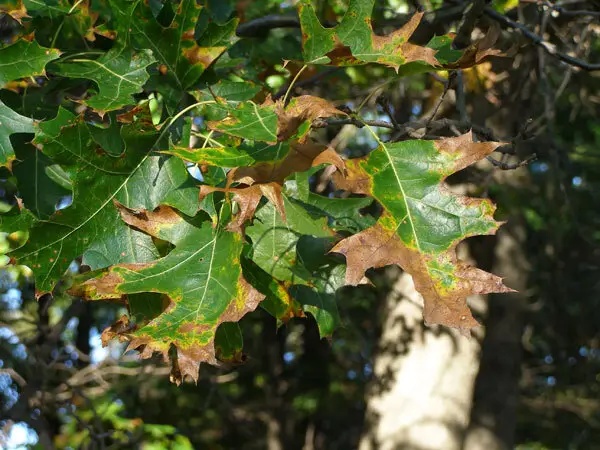
- Veinal necrosis, meaning the leaf veins turn yellow or brown while tissue between them stays green
- Premature leaf drop, often heavy and fast
- Leaves falling while partly green, browning from the tip and outer edge inward
- Sapwood streaking, visible as dark discoloration in a cut branch
- Fungal mats beneath the bark of recently killed red oaks
Symptom expression differs enough between oak groups that the same disease looks like two separate problems.
Symptoms in Red Oaks
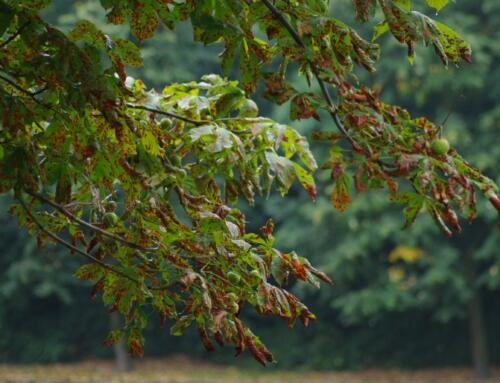
Red oaks fail from the top down. Browning starts in the upper crown and sweeps downward and outward, with leaves dropping fast enough that a homeowner notices a change week over week.
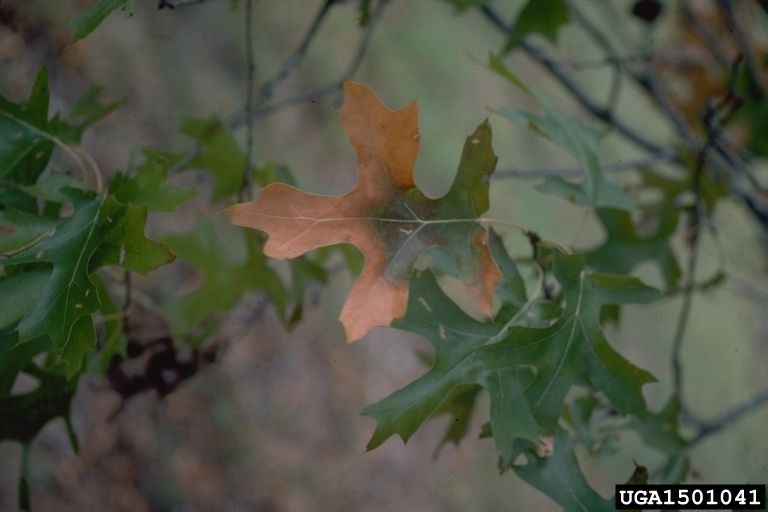
The falling leaves tell the story. Drought-killed foliage goes fully brown and brittle, while red oak leaves under wilt drop with a bronze, water-soaked look and a band of green still at the base.
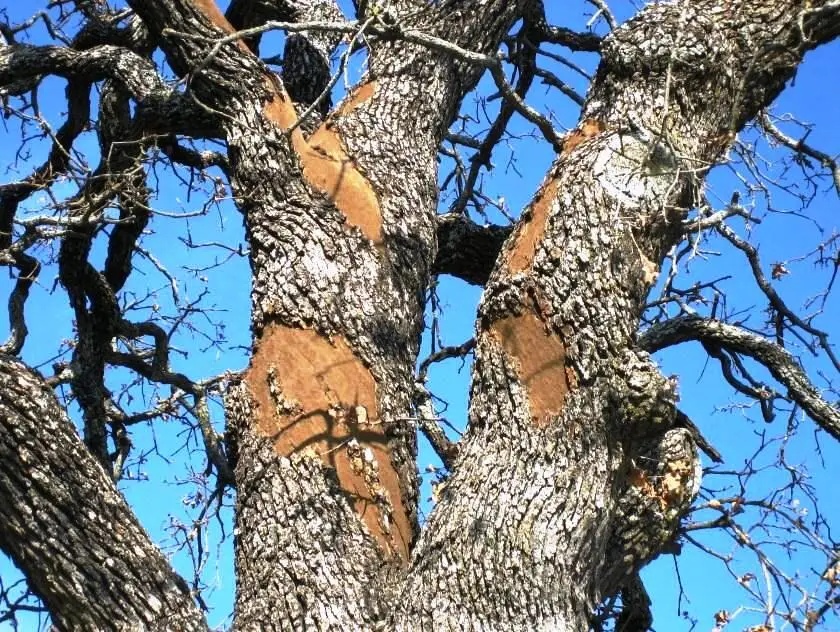
On recently killed red oaks, pressure from fungal mats under the bark creates a vertical crack in the trunk. Peel that bark back and you find a mat with a strong fruity smell, which draws the beetles that carry spores to the next tree.
Symptoms in White Oaks
Progression here is slower and far less tidy. One limb declines while the limb beside it leafs out normally, and the pattern repeats over several years instead of collapsing at once.
Because the fungus stays contained within individual growth rings, white oaks compartmentalize the infection reasonably well. Many hold on for multiple seasons, and some recover with treatment and good cultural care.
Symptoms in Live Oaks: Texas vs. the West Coast
Texas live oak is a true host of classic oak wilt, and the disease has a signature look there. Veinal necrosis shows clearly on live oak leaves, and dead trees appear in expanding circles instead of scattered singly, because live oaks share root systems across property lines.
Here is what that looks like in real life. In a Central Texas subdivision, three oaks along one fence line die in sequence over two summers while the oak across the street stays green. The pattern travels underground.
California coast live oak is a different situation. Canopy decline on a coast live oak in Marin or Santa Rosa should not be read as classic oak wilt, because the pathogen is not established there. Several other diseases and site stresses produce comparable thinning, dieback, and branch death, and the following section separates them.
How Is Oak Wilt Diagnosed?
Field symptoms narrow the possibilities without settling the question. Drought stress, root disease, borer activity, and several vascular pathogens all produce wilting and dieback that overlap heavily with oak wilt signs, so confirmation runs through a laboratory.
The process takes four steps:
- Document the pattern. Photograph the canopy, note which branches went first, and map any nearby oaks showing the same decline.
- Contact the lab before cutting. University plant diagnostic clinics and National Plant Diagnostic Network member labs handle most oak wilt testing, and each publishes its own sample requirements.
- Collect what the lab asks for. Most want actively symptomatic branch wood, because the fungus stops being recoverable once other organisms colonize dead tissue.
- Wait for culture or molecular results. Turnaround runs one to three weeks in most states.
Skipping straight to treatment on a visual guess is where money gets wasted, which the next section covers in more detail.
Is It Really Oak Wilt? Where It Occurs and What Else Looks Like It
Geography narrows the field faster than any symptom does. Before comparing leaf patterns, find out whether the pathogen exists where your tree grows.
Where Classic Oak Wilt (Bretziella fagacearum) Occurs
Classic oak wilt has been confirmed in about two dozen states, with heavy concentration in the Midwest and Texas. The core range covers Minnesota, Wisconsin, Michigan, Iowa, Illinois, Indiana, Missouri, Ohio, Kansas, Oklahoma, and Texas, with scattered detections through the mid-Atlantic and parts of the Southeast.
California, Oregon, and Washington have no established B. fagacearum population. Homeowners in those three states should watch for one wrinkle, though. Oregon agencies apply oak wilt terminology to a separate disease carried by an invasive beetle, so a search result about oak wilt in Oregon may describe something entirely different from the fungus discussed in this guide.
Mediterranean Oak Borer and Raffaelea Oak Wilt on the West Coast
Mediterranean oak borer, an ambrosia beetle first collected near Napa in 2017, carries fungi including Raffaelea montetyi. The Oregon Department of Agriculture’s Mediterranean oak borer guidance identifies the beetle as a vector of Raffaelea montetyi oak wilt and notes that Oregon white oak is susceptible.
Confirmed California detections now include Napa, Sonoma, Lake, Sacramento, Yolo, El Dorado, and Mendocino counties, with a trapped specimen in Contra Costa. In Oregon, the beetle has turned up in Oregon white oak around Troutdale in Multnomah County and Wilsonville in Clackamas County. Hosts include valley oak, blue oak, California black oak, and Oregon white oak.
Signs that separate it from classic oak wilt:
- Fine white boring dust at eye level on the trunk, in bark cracks, and at the base
- Patchy canopy failure, with healthy leaves directly adjacent to wilted, shriveled brown ones
- Black staining and branching galleries in the wood when a symptomatic branch is cut
- Top-down colonization, starting high in the canopy before beetle numbers build in the lower trunk
- A slower arc, with branches, then crown sections, then the whole tree over roughly three to five years
Treatment diverges sharply from here. The beetle favors trees already weakened by drought or root stress, so supplemental summer watering and stress reduction carry more weight than they do with classic oak wilt. Propiconazole injection, the standard treatment for B. fagacearum, does not address a beetle-carried Raffaelea infection.
Sudden Oak Death and Other Causes of Oak Decline
Several other problems mimic wilt closely enough to fool a quick look. USDA APHIS identifies Phytophthora ramorum as the cause of sudden oak death in coastal California and southern Oregon. .
| Condition | Distinguishing sign | Where it shows up |
| Sudden oak death | Dark, sticky bleeding cankers on the lower trunk | Coastal California and southwest Oregon, mainly coast live oak and tanoak |
| Armillaria root rot | White fungal fans under bark at the root collar, black shoestring rhizomes, honey-colored mushrooms | Widespread, often on trees with prior root damage or grade changes |
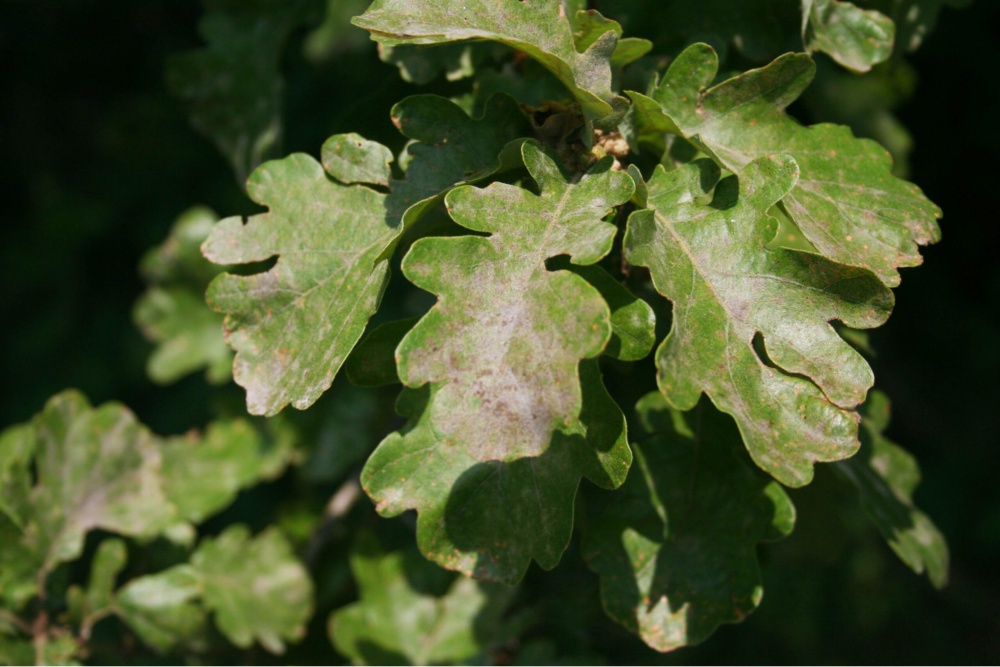
| Drought and root-zone stress | Even thinning, marginal leaf scorch, decline tied to soil conditions or construction | Everywhere, and the leading cause of oak decline in California |
| Foamy bark canker | Foamy liquid and reddish ooze from small beetle entry holes on the trunk | California coast live oak |
| Other regional causes | Varies, including bacterial leaf scorch and canker diseases | Depends heavily on region and species |
For a closer look at the two most likely West Coast culprits, see our guides to sudden oak death and Armillaria root rot. Our oak tree diseases overview covers the rest.
Why Local Diagnosis Matters Before Treatment
Tree disease treatments do not transfer between pathogens. Propiconazole injected for oak wilt does nothing against Phytophthora ramorum in a bleeding canker, and no fungicide reaches a beetle tunneling through sapwood.
The cost of guessing runs in two directions. You spend money on a treatment that was never going to work, and the actual problem keeps advancing during the months you waited to see results. A confirmed diagnosis is the cheapest step in the whole process.
What Causes Oak Wilt and How Does It Spread?
Oak wilt is caused by Bretziella fagacearum, a fungus that lives in the water-conducting tissue of oaks. Spread happens two ways, and the pattern of dying trees usually reveals which one is at work. Oaks failing one after another in a line or a widening circle point underground. A single isolated tree with fresh pruning cuts points to beetles.
Root Grafts: Underground Spread Between Oaks
Oaks of the same species growing close together fuse their roots where they touch, forming grafts that let water and nutrients move between trees. Because oak roots can extend well beyond the canopy, those connections may reach farther than the crown suggests. Think of it as shared plumbing between neighboring houses. Useful most of the time, and a fast route for contamination when something goes wrong.
The fungus travels those grafts directly from an infected tree into healthy ones, which is why infection centers expand outward year after year with no beetle involved. Root grafts also explain why a treatment plan sometimes has to cross a property line. Your neighbor’s red oak and yours may be a single connected system below ground, regardless of where the fence sits.
Trenching exists to interrupt those connections.
Sap Beetles and Fresh Oak Wounds
Sap beetles (nitidulids) feed on the fungal mats that form under the bark of recently killed red oaks. Spores stick to their bodies, and the beetles then fly to fresh wounds on healthy oaks, drawn by the same sap smell.
A wound stays attractive for a matter of days, which is the entire reason pruning timing matters so much in oak wilt country. Storm breakage, construction damage, and accidental trunk injuries carry the same risk as pruning cuts, and none of them wait for a convenient season.
Infected wood moves the disease too, particularly red oak logs cut while the fungus was active. Firewood handling gets its full treatment under prevention.
Oak Wilt Treatment Options: Treat the Tree, Protect the Oaks Around It
Every oak wilt plan answers two separate questions. What happens to the affected tree, and how do you stop the infection center from expanding into the oaks nearby? The strongest results usually come from pairing an individual-tree treatment with a containment measure.
Oak Wilt Treatment Options at a Glance
| Method | What it does | Best for | Typical timing | Approximate cost | Limitations |
| Preventive fungicide injection | Protects uninfected sapwood before the fungus arrives | Healthy high-value oaks within about 100 feet of a confirmed case | Spring or fall, while the tree moves water actively | Roughly $10 to $25 per inch of trunk diameter | Temporary, repeat every 1 to 2 years, no effect on root graft transmission |
| Therapeutic fungicide injection | Slows an infection already underway | White oaks and live oaks with less than 30 percent crown loss | As soon after diagnosis as the tree can take up product | Similar per-inch pricing, sometimes higher dosing | Rarely useful in symptomatic red oaks, no eradication |
| Root graft trenching | Severs underground connections around an infection center | Groups of same-species oaks growing close together | Before or immediately alongside removal | Often $5 to $15 per linear foot on open sites | Limited by utilities, hardscape, slopes, and shallow bedrock |
| Removal plus wood management | Eliminates the spore source and the fungal mat risk | Dead and near-dead red oaks | Dormant season where local rules allow | Commonly $800 to $3,500 per tree by size and access | Removal alone leaves root grafts intact |
| Monitoring only | Tracks progression before you commit money | Low-value trees, unconfirmed cases, isolated white oaks | Ongoing, with seasonal checks | Consultation fee only | Risk climbs if the lab result comes back positive |
Fungicide Injection for Oak Wilt
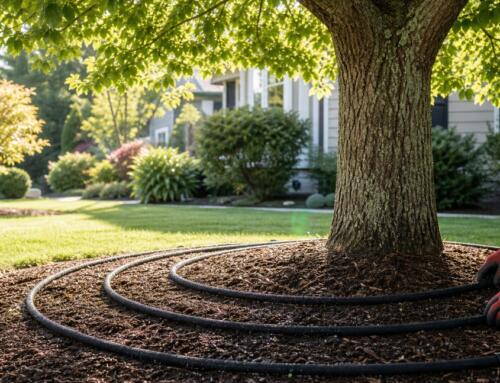
The active ingredient is propiconazole, sold for tree injection under names including Alamo and Propizol. Application uses macro-infusion, where an arborist drills small ports into the root flare and delivers a measured volume of diluted product under pressure so the tree distributes it through the water-conducting tissue.
Preventive use is where the science is strongest. Injecting healthy oaks around a confirmed infection center protects them if spores or fungal growth reach them later, and results in high-value landscape trees hold up consistently well.
Therapeutic use is narrower. A white oak or live oak caught early, with limited crown loss, sometimes stabilizes. A symptomatic red oak almost never does.
Set expectations on two points. Propiconazole suppresses fungal growth inside treated wood without eliminating an infection center, and it offers no barrier to root graft transmission at all. Protection also fades, so retreatment falls at roughly one to two year intervals depending on product, disease pressure, and your arborist’s read on the site.
Is There a Spray for Oak Wilt?
No effective canopy spray exists for oak wilt. The fungus lives inside the vascular tissue of the trunk and branches, well beyond the reach of anything applied to leaf surfaces.
Systemic delivery through injection is the only way to place fungicide where the pathogen actually lives. Any product marketed as a foliar oak wilt cure is worth skepticism.
Stopping Spread Through Root Grafts
Trenching severs the fused roots between infected and healthy oaks. A vibratory plow or trencher cuts a line commonly around 4 to 5 feet deep, though soil type, rock, and root architecture all affect how deep the cut needs to go on a given site.
Placement decides whether the effort works. The trench line goes outside the symptomatic trees, generally beyond a buffer of one or two apparently healthy oaks, because trees showing no symptoms yet may already carry the fungus. Cutting too close to the visible edge of an infection center leaves infected roots on the protected side.
Urban sites complicate the picture. Water lines, gas, irrigation, fiber, driveways, retaining walls, and mature landscaping all restrict where a trench can run, and some properties cannot accommodate a continuous line at all. Partial trenching still helps in many cases, with expectations adjusted for the gaps. Either way, a trench protects the neighborhood and does nothing for the infected oak inside the line.
Removing Infected Oaks
Removal becomes the right call once a red oak is dead or clearly failing, and it matters most for spore control. Fungal mats form on recently killed red oaks, and each mat is a launching point for beetles carrying spores to fresh wounds elsewhere.
Sequence matters. Where trenching is part of the plan, cut the root connections first or at the same time. Removing an infected tree without severing grafts sometimes accelerates fungal movement into neighboring oaks as the dying root system releases its hold.
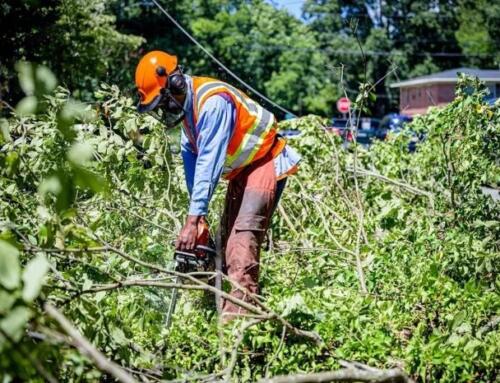
Wood from an infected oak needs handling instead of casual stacking. Debarking removes the layer where mats form, chipping destroys the habitat outright, and burial or approved disposal works where the volume is large. Dormant-season removal cuts beetle risk substantially, and several states restrict removal timing outright. Large oaks near structures or power lines belong to a crew with the right equipment, which our tree removal service handles.
When Should Oak Wilt Be Treated?
Timing follows the biology, not the calendar. Fungicide injection works when the tree is actively moving water, which means spring after full leaf-out or early fall, and uptake suffers during midsummer heat and drought stress.
Removal and trenching belong in the dormant season wherever that scheduling is workable, since beetle activity drops sharply and fresh cut surfaces attract far less attention.
Oak species, how advanced the infection is, regional climate, and state guidance all shift these windows. Pruning follows its own rules, covered under high-risk periods.
What Does Oak Wilt Treatment Cost?
Oak wilt work is priced in five parts:
- Fungicide injection, priced per inch of trunk diameter, commonly $10 to $25 per inch, so a 24-inch oak runs roughly $240 to $600 per application
- Trenching, priced by linear foot or as a project, often $5 to $15 per foot with clean access
- Removal, typically $800 to $3,500 per tree depending on size, proximity to structures, and crane requirements
- Wood handling and disposal, including chipping, debarking, and hauling
- Follow-up monitoring, usually an annual assessment plus retreatment where needed
What moves those numbers: trunk diameter, how many trees need treatment, whether the work is preventive or therapeutic, site access for equipment, trench length, buried utilities and hardscape, regional labor rates, and removal complexity.
Ranges above reflect general market figures reported across oak wilt regions and are not A Plus Tree pricing. Any real estimate comes from an on-site assessment.
Not sure what is wrong with your oak? A Plus Tree offers free tree assessments across Northern California, Southern California, Seattle, Tacoma, and Portland. Getting the diagnosis right costs nothing and saves the money you would otherwise spend treating the wrong problem. Request an assessment
How to Prevent Oak Wilt
Oak wilt prevention comes down to controlling wounds, timing, and wood movement. Add one more habit worth building: watch the healthy oaks near any confirmed case. Trees within about 100 feet of an infection center deserve a seasonal look at the upper canopy, since early flagging in a treatable white oak beats discovering the problem two seasons later.
Avoid Pruning During High-Risk Windows
Sap beetles find fresh wounds within hours, and a pruning cut stays attractive for a few days. Skipping cuts during peak beetle activity removes the single largest controllable risk.
High-risk periods differ by region, and following the wrong state’s calendar defeats the purpose.
| Region | High-risk pruning period | Safest window |
| Central Texas | February through June | July through January, with midwinter preferred |
| Minnesota and Wisconsin | April through July | November through March |
| Michigan and the upper Midwest | April 15 through July 15 | Late fall and winter |
| States with no established oak wilt | No oak wilt restriction | Follow standard pruning practice for the species |
A good practical rule: in any state where oak wilt occurs, follow your state forestry agency or extension service calendar, and schedule oak pruning for the coldest part of winter when nothing is flying.
Protect Fresh Wounds When Pruning Is Unavoidable
Storms break limbs on their own schedule. Construction equipment scrapes trunks. A stray mower catches a root flare. When an oak gets wounded during high-risk season, seal the wound the same day, ideally within minutes.
General arboriculture advises against routine wound dressing, since sealed cuts trap moisture and slow natural compartmentalization. Oak wilt is the recognized exception. Blocking beetle access for a few critical days outweighs the modest downside, and either a commercial pruning paint or ordinary latex paint works.
Regional context applies here too. Sealing wounds makes sense in oak wilt country and offers little benefit where the pathogen does not occur.
Managing Firewood and Cut Wood
Recently cut red oak is the highest-risk material, because fungal mats form on wood that still holds moisture and inner bark. A stack of fresh red oak beside a house sits directly next to the fresh wounds you want to protect.
Practical handling rules:
- Debark logs you plan to keep, since mats develop between bark and sapwood
- Chip smaller material outright, which eliminates the habitat
- Dry wood fully for at least a year before storing it near living oaks
- Cover suspect stacks with clear plastic sealed at ground level through a full warm season where your state recommends it
- Check state and county quarantine rules before moving any oak wood
- Never transport firewood between regions, which spreads oak wilt and Mediterranean oak borer alike
Buy firewood where you burn it. The advice sounds minor and does more to slow long-distance pest movement than almost anything else a homeowner controls.
From One Oak to a Whole Property: A Plus Tree’s Approach
Oak wilt rarely stays a single-tree problem, which is why our approach starts with the site instead of the specimen. A property with twelve mature oaks and one failing tree presents a very different set of decisions than a single specimen oak in a front yard, and the plan should reflect that.
Confirm the Cause, Then Prioritize by Risk
Diagnosis comes first, every time. Our certified arborists work through whether the problem is classic oak wilt, a beetle-carried wilt like Mediterranean oak borer, sudden oak death, root disease, or site stress, because the treatment paths separate immediately after that answer. Our arborist consulting team handles that assessment and the plan that follows.
Once the cause is clear, we prioritize by weighing:
- Tree condition and how much canopy remains
- Structural risk to homes, driveways, play areas, and power lines
- Tree value, including size, species, placement, and what replacement would take
- Neighboring exposure, particularly same-species oaks within root graft range
- Site conditions such as soil, drainage, irrigation, and recent construction
- Property-wide patterns that suggest a shared underlying cause
For HOAs, multifamily communities, commercial sites, and municipal portfolios, our ArborPlus platform holds the tree inventory, treatment history, and monitoring schedule in one place, so a five-year disease management plan stays traceable across staff changes and budget cycles.
Three points carry most of the weight in any oak wilt decision. Confirm the pathogen before you spend money on treatment, act early because red oaks give you weeks rather than seasons, and treat the surrounding oaks as part of the same problem. If your oaks are declining anywhere across Northern California, Southern California, Seattle, Tacoma, or Portland, schedule a free assessment and we will tell you what is actually happening in your trees, then walk through the options worth considering.
Oak Wilt Treatment FAQs
Can You Treat Oak Wilt Yourself?
DIY injection kits exist, though diagnosis, dosage, and injection technique all affect the outcome. Professional treatment matters most with high-value trees, and commercial application generally requires applicator licensing.
What Should I Do If My Neighbor’s Oak Has Oak Wilt?
Have your oaks evaluated promptly, since root grafts cross property lines. Fungicide alone will not block underground spread, so effective containment usually requires trenching coordinated between both properties.
Can I Plant a New Oak Where One Died of Oak Wilt?
Yes. The fungus survives in living roots and wood, not in ordinary soil, so grind the stump, address remaining root connections, and follow local guidance on species choice.
How Long Does Oak Wilt Treatment Last?
Preventive propiconazole protection is temporary. Most treated oaks need retreatment after roughly one to two years, with the interval depending on product, disease pressure, and your arborist’s assessment.
Get a Free Tree Assessment — No Obligation
Tell us about your tree. One of our ISA Certified Arborists will review your situation and get back to you within 24 hours.