
Every fall, homeowners across our service areas ask some version of the same question: is it too late to plant that tree? In many cases, the answer is no. In fact, fall is often one of the best times to plant trees, and professional tree planting and transplanting is often easiest to time successfully when warm soil, cooler air, and seasonal rainfall give roots a chance to establish before spring growth begins. Deciduous trees usually respond especially well, while evergreens often need earlier timing and a little more attention after planting.
Quick Answer: In much of California and the Pacific Northwest, fall planting gives new trees a strong head start, as long as the soil is still workable and the tree goes in before the first hard frost window closes. That makes timing, species selection, and site conditions the three things that matter most.
This guide walks you through how to read your regional planting window, which trees are best suited for fall installation, and the step-by-step methods our certified arborists use to help new plantings establish successfully.
Whether you are deciding if it is too late to plant, choosing between deciduous trees and evergreens, or preparing a young tree for its first winter, you will find practical answers here.
Is It Too Late to Plant? Understanding the Fall Window
The fall planting window is wider than most people expect. Many homeowners assume that once temperatures drop, the planting season is over. In reality, the soil stays warm and workable long after air temperatures cool, which means trees can continue establishing roots well into autumn.
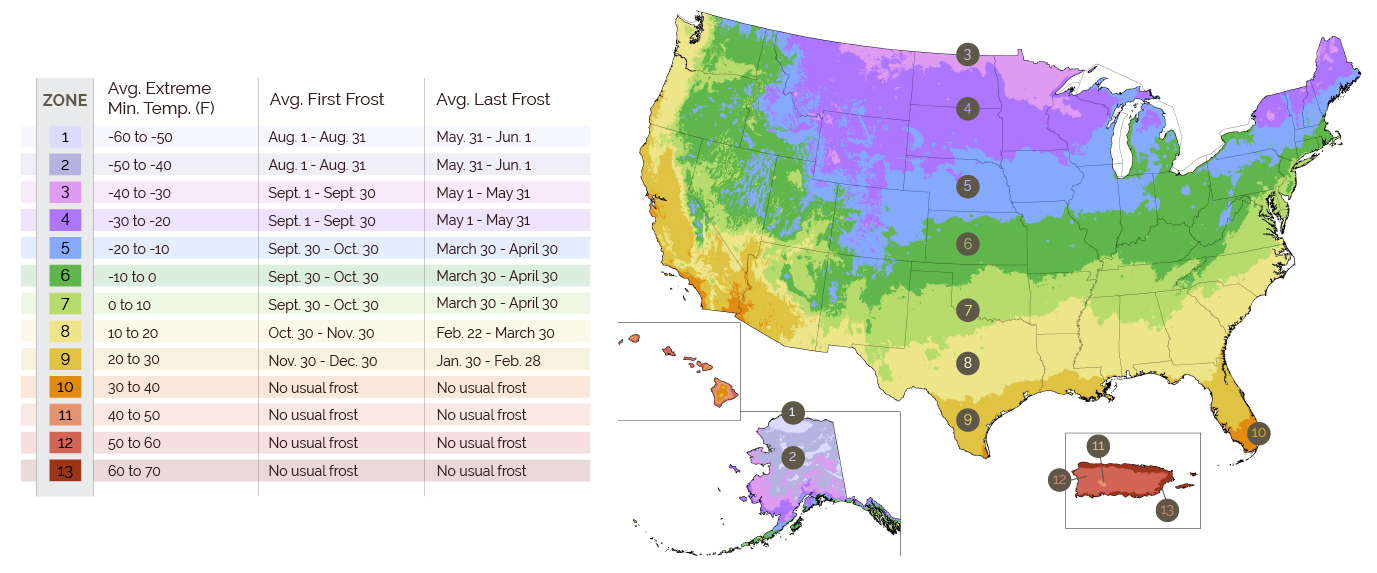
The key is understanding exactly where your boundary is, and that boundary depends on three things: your local frost dates, the species you are planting, and the specific conditions of your site. The USDA Plant Hardiness Zone Map is a useful starting point for understanding your area’s winter minimums, but local frost timing still matters when you are deciding how late you can safely plant.
The Golden Rule: Planting Before the First Hard Frost
A hard frost occurs when temperatures drop to 28°F or below long enough to freeze plant tissue (typically several hours), which aligns with NOAA’s Hard Freeze Warning threshold. That threshold matters because it is the point at which soil temperatures begin dropping fast enough to slow root activity significantly.
The practical rule our arborists follow is to plant at least six weeks before the first expected hard frost. This gives a newly planted tree enough time to begin anchoring new root growth before the ground locks up for winter. Think of it like laying a foundation: the tree needs some time to set before the cold moves in.
If your area is heading toward that six-week mark, it does not necessarily mean you have missed your window. It means you need to act soon and give the tree extra support through mulching and deep watering.
Deciduous vs. Evergreens: Why Timing Varies by Species
Not all trees respond to fall planting the same way, and the biggest dividing line is between deciduous trees and evergreens.
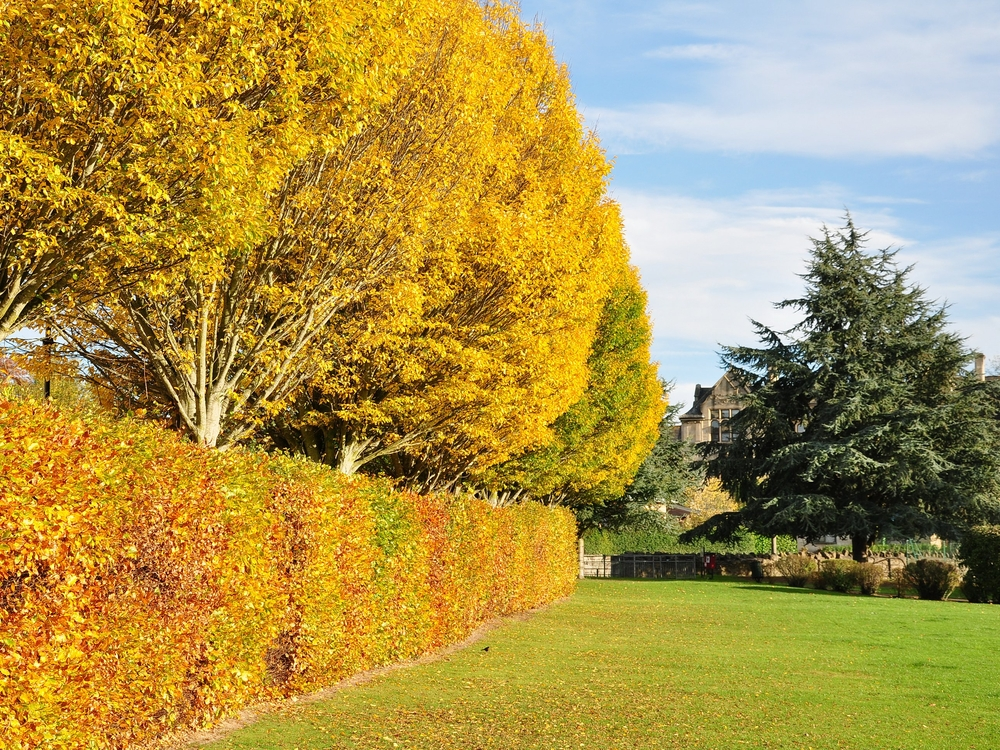
Deciduous trees, those that drop their leaves in autumn, are generally excellent candidates for fall planting. Once they begin dropping leaves, they enter a state called dormancy, meaning their above-ground growth has paused. The plant is not idle, though.
Below the soil, roots continue to grow in cool soil whenever the ground temperature stays above 40 degrees Fahrenheit. This means a dormant deciduous tree can spend the entire fall and early winter quietly building the root structure it needs.
Evergreens are more sensitive. Because they retain their foliage year-round, they continue losing moisture through their needles even in cold weather. A newly planted evergreen that has not yet established a strong root system is at higher risk of winter desiccation, drying out from the top down even when water is available. Evergreens can be planted in fall, but timing matters more, and they generally need more post-planting attention than deciduous species.
Regional Timelines: When to Stop Planting in Our Service Areas
A Plus Tree serves communities across California and the Pacific Northwest, and fall planting timelines vary meaningfully across those regions.
Northern California and the Bay Area
Fall is one of the strongest planting seasons here. Mild temperatures, cooling air, and the approach of winter rains create near-ideal conditions. Most areas can plant deciduous trees confidently through November, with coastal locations often extending that window even further.
Southern California and Los Angeles
Fall planting here is not a sprint against the clock the way it is in colder climates. Once temperatures moderate in September and October, conditions become excellent. The combination of warm soil and cooler air is about as good as it gets for new tree establishment.
Pacific Northwest (Portland and surrounding areas)
Hard frosts arrive earlier here, typically in October and into November depending on the year. The target planting window for deciduous trees runs through mid to late October. Evergreens should go in earlier, ideally by early October, to allow adequate root establishment before the ground cools.
Not sure if your tree needs professional attention?
A Plus Tree’s ISA Certified Arborists serve homeowners across the West Coast. A free assessment takes 15 minutes and gives you a clear answer.
Why Fall is Often Superior to Spring Planting
When comparing fall and spring tree planting, fall frequently comes out ahead. The biology of tree establishment strongly favors the fall conditions that exist in most of our service areas, and understanding why helps explain what the tree actually needs from the moment it goes into the ground.
Thermal Mass: How Warm Soil Boosts Root Development
Soil does not cool down as quickly as air does. After a summer of absorbing heat, the ground holds warmth well into autumn, and that thermal mass is exactly what roots need to grow. Soil temperatures in the upper root zone typically remain above 50 degrees Fahrenheit in Northern California and the Bay Area well into December, and above 40 degrees in Portland through October and November.
Root growth is directly tied to soil temperature. A helpful way to picture it is this: the soil acts like a warm room the tree can keep working in long after the air outside has turned cold. In spring, trees are competing with themselves, pushing energy toward leaf and stem growth at the same time roots are trying to establish.
In fall, the tree channels its energy almost entirely underground, building the anchor and uptake system that will fuel everything else.
Natural Dormancy: Minimizing Transplant Shock
Transplant shock is the period of stress a tree experiences after being moved from one growing environment to another. It is real, it is normal, and it can range from mild to severe depending on timing and technique.
Fall planting dramatically reduces the severity of transplant shock in deciduous trees for a straightforward reason: the tree is already slowing down. Its hormonal signals are pointing toward rest, not growth. Moving a tree into a new location while it is entering dormancy is much less disruptive than moving one in spring when it is in active growth mode and every system is running at full demand.
Here is what this looks like in real life: a red maple planted in spring will often drop leaves, look wilted, and struggle for weeks as it tries to establish while simultaneously pushing new growth. The same species planted in early November may look quiet all winter and then burst into strong, healthy growth in spring because its roots had months to get settled.
Reduced Water Stress and Lower Maintenance Costs
Fall planting comes with a practical financial advantage. Spring-planted trees face the double pressure of establishment stress and summer heat, which means they need a consistent watering schedule for newly planted trees through their first growing season. In California, that schedule can run for months and requires real attention.
Fall-planted trees move into winter with cooler temperatures and, in many of our service areas, natural rainfall that handles much of the supplemental irrigation for them. Root growth continues through the mild months, and by the time heat returns in summer, the tree has a meaningful head start on the root structure it needs to tolerate dryness. The result is lower first-year water costs and a more resilient tree.
What to Plant: Best (and Worst) Species for Fall
Choosing the right species is one of the most consequential decisions in the fall planting process. A tree that is a good fit for the season and the site will establish with far less intervention than one planted in conditions it is not suited for.
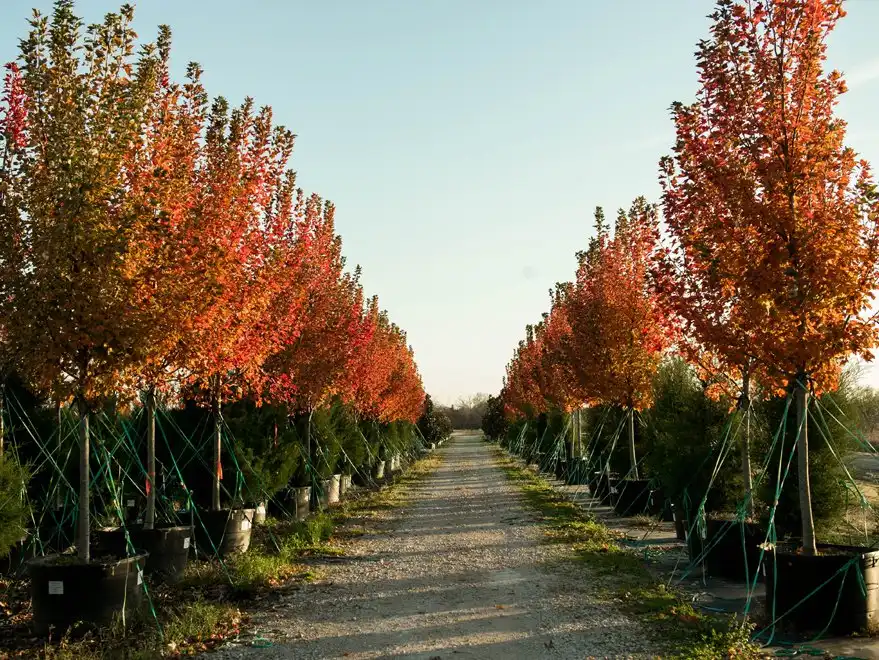
Top Deciduous Trees for Late-Season Success
These species consistently perform well when planted in fall across our California and Pacific Northwest service areas:
Valley Oak (Quercus lobata)
Native to California, extremely drought-tolerant once established, and highly adaptable to clay soils. Fall planting aligns perfectly with its natural growth cycle.
Red Maple (Acer rubrum)
Reliable fall performer across a wide range of soil conditions. Excellent root establishment rate, beautiful fall color, and a strong choice for residential properties.
Ginkgo (Ginkgo biloba)
Hardy, long-lived, and remarkably tolerant of urban growing conditions. Goes dormant reliably and handles fall transplanting well.
Chinese Pistache (Pistacia chinensis)
One of the best choices for California fall planting. Drought-tolerant, adaptable, and produces exceptional fall color.
Tulip Poplar (Liriodendron tulipifera)
A fast-growing option that takes well to fall planting, particularly in the Pacific Northwest. Needs good drainage.
Raywood Ash (Fraxinus oxycarpa ‘Raywood’)
Widely used in commercial and residential landscapes in California, performs well with fall installation.
Caution List: Why Some Trees Prefer a Spring Start
Some species are better held until spring, particularly in regions where fall transitions to hard frost quickly.
Sweetgum (Liquidambar styraciflua)
Moderately cold-sensitive roots. Performs better with a spring start in areas north of the Bay Area.
Southern Magnolia (Magnolia grandiflora)
An evergreen broadleaf that continues to transpire moisture through fall and winter. Fall planting increases desiccation risk without careful post-planting management.
Jacaranda (Jacaranda mimosifolia)
Thrives in Southern California but is cold-sensitive and does not hold up well in cool fall soils outside of its warmest growing zones.
Japanese Maple (Acer palmatum)
The species itself is fine with fall planting, but named cultivars and specialty grafted varieties are more sensitive to establishment stress and generally prefer spring installation.
Any tropical or subtropical species
Reserve these for spring in all but the mildest coastal California locations.
Professional Selection Table: Growth Rates and Soil Preferences
Not every tree that performs well in fall performs equally well on every site. The table below gives you a professional starting point for comparing growth rate, soil preference, and overall fall planting fit, so you can narrow your options before making a final species decision.
| Species | Growth Rate | Soil Preference | Fall Planting Suitability | Notes |
| Valley Oak | Slow to moderate | Clay, loam, well-draining | Excellent | California native, drought-resilient |
| Red Maple | Moderate to fast | Adaptable, prefers moist | Excellent | Wide regional range |
| Ginkgo | Slow to moderate | Well-draining, tolerant | Excellent | Very urban-tolerant |
| Chinese Pistache | Moderate | Well-draining, clay-tolerant | Excellent | Strong California performer |
| Tulip Poplar | Fast | Rich, well-draining | Good | Pacific Northwest preferred |
| Raywood Ash | Moderate to fast | Adaptable | Good | Widely used in CA landscapes |
| Southern Magnolia | Moderate | Well-draining, acidic | Caution | Evergreen, moisture-sensitive |
| Japanese Maple (cultivar) | Slow to moderate | Rich, well-draining | Caution | Prefer spring for grafted varieties |
| Jacaranda | Moderate | Sandy, well-draining | Avoid outside warmest zones | Cold-sensitive below 25°F |
The A Plus Way: Step-by-Step Professional Planting Standards
A tree planted well in fall has the potential to establish faster, grow stronger, and require less intervention than one planted carelessly in the best possible season. The planting process itself is where most long-term outcomes are decided. These are the standards our arborists follow on every installation.
Site Assessment: Soil Compaction and Drainage Tests
Before a shovel goes into the ground, we evaluate two things: compaction and drainage. Both problems are common in residential and commercial landscapes, and both will limit a tree’s ability to establish regardless of the season.
Compaction is tested by pushing a metal rod or penetrometer into the soil. In healthy planting soil, you should be able to push it 12 inches deep with moderate hand pressure. If it stops at 4 or 5 inches, compaction is significant enough to restrict root growth, and the site may have broader common soil problems that need to be addressed before planting.
Drainage is assessed with a simple percolation test. Dig a hole approximately 12 inches deep and 12 inches across, fill it with water, and let it drain. Fill it again and check the rate. Well-draining soil will drop an inch per hour or faster. Standing water after 24 hours indicates a drainage problem that must be addressed before planting.
Finding the Root Flare: The Most Common Planting Mistake
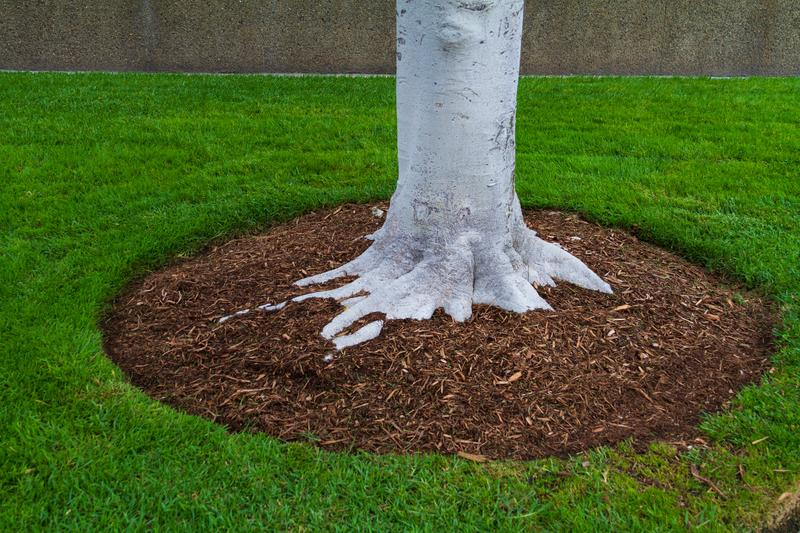
The root flare is the visible widening at the base of a tree’s trunk where it transitions into the root system. It should sit at or very slightly above finished grade after planting.
Burying the root flare, or planting a tree too deep, is the single most common and damaging mistake in tree installation. A tree planted even two or three inches too deep will struggle for years. The bark at the base of the trunk is not designed to be underground, and chronic moisture contact leads to rot, fungal problems, and long-term structural decline.
When you receive a containerized or balled-and-burlapped tree, the root flare may already be buried in the nursery soil. Always excavate down to find the actual flare before setting the tree in the hole. The hole depth should match the distance from the flare to the bottom of the root ball, not the visible top of the soil in the container.
Handling Root Systems: From Balled-and-Burlapped to Containers
How a tree arrives from the nursery helps determine how it should be handled during planting. Our arborists adjust their approach based on the root system, but the goal stays the same: protect root integrity, reduce transplant stress, and give the tree the best possible start before winter sets in.
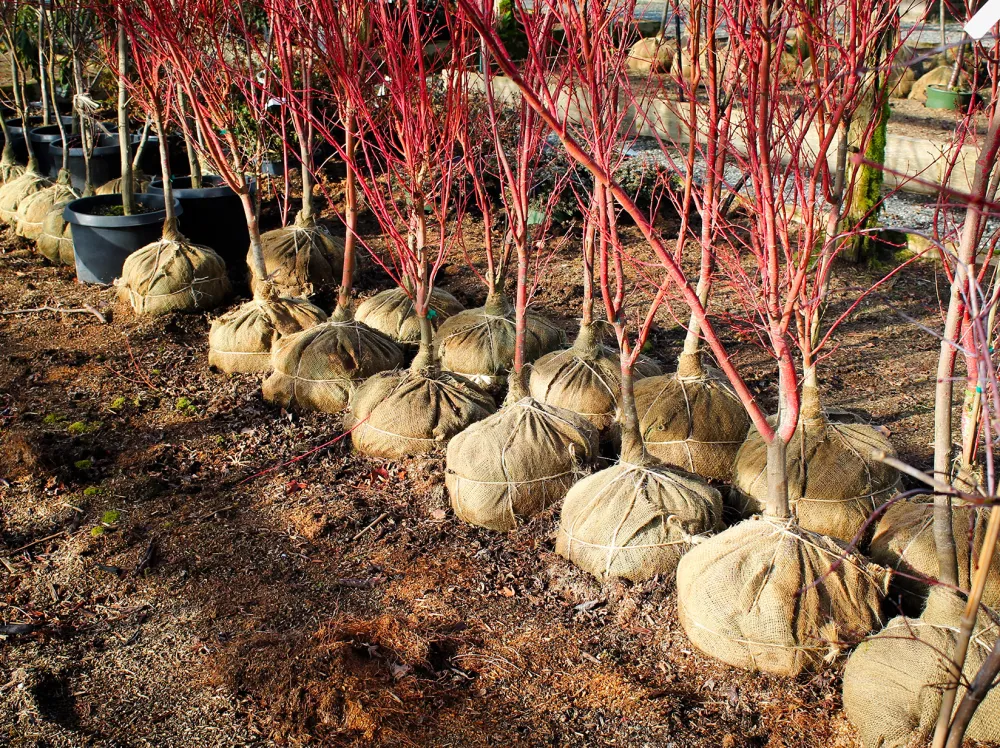
Balled-and-burlapped (B&B)
These trees arrive with their root ball wrapped in natural burlap and secured with wire. Remove the wire basket and fold back the burlap at a minimum after setting the tree. Natural burlap breaks down over time, but synthetic burlap does not, and even natural burlap can restrict root growth if left in place around the top of the ball. Cut it away as much as possible once the tree is positioned correctly.
Containerized trees
Remove the container entirely and inspect the roots. If you see roots circling around the inside of the pot, score the root ball vertically with a knife in two or three places to interrupt the circling pattern. Circling roots that are not addressed will continue to grow in that pattern, eventually girdling the tree and cutting off its own vascular flow.
Bare root trees
These are less common in fall but occasionally available for certain species. Plant immediately after receipt. Do not allow roots to dry out, and spread them naturally in the planting hole without forcing them into an unnatural shape.
Soil Amendments: Using Biochar and Professional Arbor Mulch
In most cases, we recommend backfilling with the native soil removed from the planting hole. The reason is practical: if the tree grows in a high-quality soil pocket surrounded by dense native soil, its roots may stay within that pocket and never spread outward into the surrounding ground.
That said, targeted amendments make a real difference in two scenarios: heavily compacted clay soils and very sandy, low-nutrient soils.
Biochar is one of the amendments we use regularly at A Plus Tree. It is a form of activated carbon produced from organic material, and USDA notes that biochar can improve drainage, aeration, and water retention, while also supporting the microbial environment that healthy roots depend on.
In clay-heavy soils, it improves aeration. In sandy soils, it helps retain moisture and nutrients. It is incorporated into the backfill at a ratio of approximately 10 to 15 percent by volume.
Our professional Arbor Mulch is applied to the surface of the planting area, never mixed into the hole itself. Surface mulch serves a different function than in-soil amendment: it moderates soil temperature, retains moisture, and suppresses competing vegetation. In fall planting, it also insulates the root zone against temperature swings as winter approaches.
Critical Fall Tree Care: Keeping Your Investment Alive
Planting the tree correctly gets it started. What happens in the weeks and months that follow determines whether it thrives or struggles. Fall care has a specific rhythm because the tree is heading into dormancy, not out of it.
Deep Root Watering Strategies Before the Ground Freezes
Fall-planted trees need deep, infrequent watering rather than frequent shallow applications. The goal is to push moisture down into the root zone, roughly the bottom 12 to 18 inches of the root ball, where it will be most useful during the cold months ahead.
A slow, deep watering once or twice per week during dry fall weather is generally appropriate for most regions in our service area. In Southern California, where winter rainfall is less reliable, maintain this schedule through November and beyond. In Northern California and the Pacific Northwest, natural rainfall often takes over the workload by late October.
The most important watering event of fall planting is the final deep irrigation before the ground freezes. This fills the soil with moisture that the root zone can hold and access through the winter, even when surface conditions are dry or frozen.
Avoid watering when the soil is already saturated. Waterlogged root zones in cold temperatures are a significant risk for newly planted trees, as cold, wet soil limits oxygen availability to roots and promotes fungal activity.
The “Donut” Mulching Technique for Winter Insulation
Mulch is one of the most powerful tools in fall tree care, and applying it correctly matters as much as applying it at all.
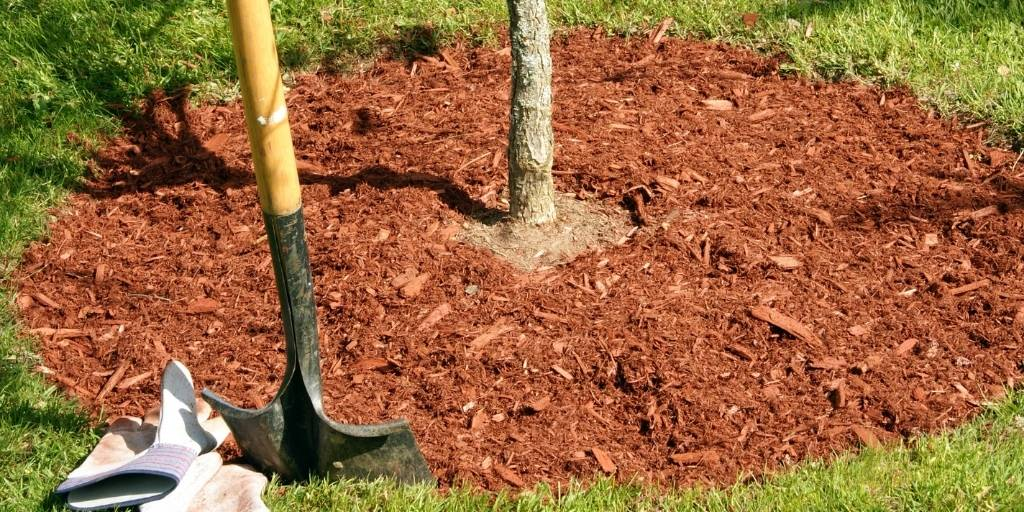
The donut technique involves spreading a ring of mulch three to four inches deep, extending out from the trunk to the edge of the drip line when possible, while keeping a clear gap of at least three to four inches immediately around the trunk itself. That gap is critical. As the USDA’s mulch guidance also notes, mulch piled against the bark traps moisture and creates conditions where rot and pest damage are far more likely.
Think of the donut shape as a rain barrel laid flat around the base of the tree. It holds soil moisture, moderates the temperature of the root zone, and insulates against hard freezes without creating the trunk contact that causes bark problems.
For young trees planted in fall, we typically recommend a four-inch mulch layer. In the coldest areas of our service range, five inches provides meaningful additional insulation for the root zone during hard freezes.
Protecting Young Bark from Sunscald and Winter Pests
Sunscald is a type of bark injury that occurs in late winter when warm winter sun heats the bark on the south and southwest-facing sides of a young tree, causing the tissue to come out of dormancy. When temperatures drop again at night, that tissue refreezes and dies. The result is a patch of dead, cracked, or sunken bark that can serve as an entry point for insects and disease.
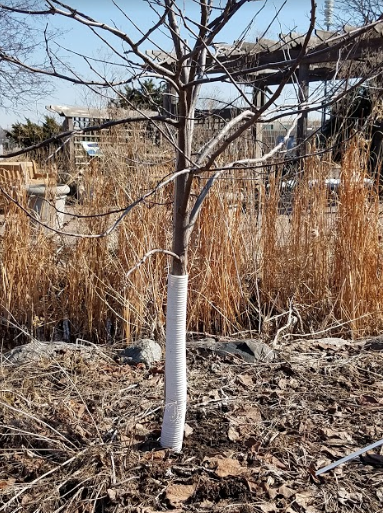
Young trees with thin bark are the most vulnerable. The solution is straightforward: wrap the lower trunk from the base to the lowest branch with a commercial tree wrap or white plastic trunk guard. Install it in fall after planting and remove it in spring once the risk of hard overnight freezes has passed.
Voles and rabbits are also real concerns for newly planted trees in late fall and winter. These animals feed on bark near the soil line when other food sources become scarce. A wire mesh cylinder around the base of the trunk, extending a few inches below the mulch line and at least 24 inches above the expected snow line, provides reliable protection.
When to Call a Certified Arborist for Fall Planting
Smaller trees in straightforward locations are often well within the reach of a capable homeowner who follows the steps above. Larger installations, challenging sites, and multi-tree projects are a different matter, and getting professional guidance at the outset usually saves both time and money over the life of the planting.
Managing Large-Scale Urban Forest Projects
Planting at scale introduces variables that individual installations do not: soil consistency across a site, irrigation design, species diversity planning, canopy spacing, and coordination with utilities and infrastructure. These are not details to work out after the trees are in the ground.
At A Plus Tree, we work with HOA communities, municipalities, commercial properties, and large residential estates on urban forest installations. That scope of work typically begins with a site assessment that maps drainage patterns, existing root competition, utility line locations, and microclimate variations across the property before a single species selection is made.
Getting those decisions right from the beginning means every tree placed has a realistic shot at long-term success. Replacing a poorly sited tree three years after installation costs far more than the initial assessment would have.
Digital Tree Tracking and Long-Term Care with ArborPlus
One of the most practical tools we offer clients is access to ArborPlus, our proprietary tree management platform. After installation, each tree is documented with its species, location, planting date, site conditions, and any post-planting observations. Over time, that record becomes a complete care history.
For property managers overseeing dozens or hundreds of trees, ArborPlus allows them to monitor watering schedules, review care recommendations, track tree health over time, and coordinate service visits from a single platform. For residential clients, it provides a clear picture of what their trees have been through, what they need, and when to act.
Fall is an excellent time to set up or update your digital tree inventory, particularly if you have new plantings going in. Starting the record at the time of installation captures the most important baseline data while it is fresh.
Frequently Asked Questions About Planting Trees in Fall
Is Fall or Spring Better for My Specific Region?
In most California and Pacific Northwest regions, fall planting gives deciduous trees a longer root establishment window before summer heat arrives, making it the stronger season overall.
Can I Plant After the First Snowfall?
You can, provided the soil beneath the surface remains unfrozen and workable. Check before digging, plant promptly, and prioritize a deep watering immediately after installation.
How Do I Know if My Tree Survived Its First Winter?
Scratch a small section of bark on a young branch in early spring. Green tissue beneath means the tree is alive. Wait until late spring before drawing conclusions, as some species leaf out later.
Fall tree planting is one of the most rewarding investments you can make in your property, and the season rewards those who approach it with the right preparation and realistic expectations. The biology supports you, the conditions in most of our service areas extend the window well into autumn, and a tree established in fall typically arrives at its first summer stronger and better rooted than one planted in spring.
If you are ready to plant this fall or want professional guidance on species selection, site conditions, or installation for a larger project, our certified arborists are here to help. Contact your nearest A Plus Tree location to request a proposal.
Get a Free Tree Assessment — No Obligation
Tell us about your tree. One of our ISA Certified Arborists will review your situation and get back to you within 24 hours.