
A tree that brings shade, flowers, or privacy to your yard should also suit the water available to it. Drought-tolerant trees offer useful options, but choosing well means looking beyond a low-water label.
From spreading oaks to smaller flowering trees, the choices below suit different Western climates and planting spaces. Good long-term tree health care starts with that match between species, soil, and surroundings. Compare their mature size and practical limitations, then consider the care each will need while its roots establish.
What Does Drought Tolerance Mean for Trees?
Drought tolerance is a tree’s ability to withstand periods of limited water. For newly planted trees, drought tolerance comes after establishment, and it does not guarantee healthy growth through every drought.
Think of the soil as a water reservoir and the roots as the tree’s access to it. A newly planted tree has roots concentrated in a small area, so it cannot yet reach moisture throughout the surrounding ground. Even a drought-adapted species needs attention during that transition.
In gardening, “drought resistant” often describes similar qualities. Heat tolerance is a separate consideration: a tree may tolerate dry soil yet struggle with intense reflected heat beside pavement.
There is no single tree that needs the least water in every setting. Rainfall, soil depth, mature size, and growing conditions influence the answer. The most useful choice is one adapted to the conditions your property can provide.
Not sure if your tree needs professional attention?
A Plus Tree’s ISA Certified Arborists serve homeowners across the West Coast. A free assessment takes 15 minutes and gives you a clear answer.
Drought-Tolerant Trees to Consider for Your Landscape
These ten trees offer different combinations of shade, flowers, evergreen foliage, and fruit. All need suitable establishment care.
The dimensions below are approximate planning ranges, not guaranteed limits. Cultivars, climate, and growing conditions can change the eventual size. Check the specific plant before buying, particularly where buildings or utilities restrict its space.
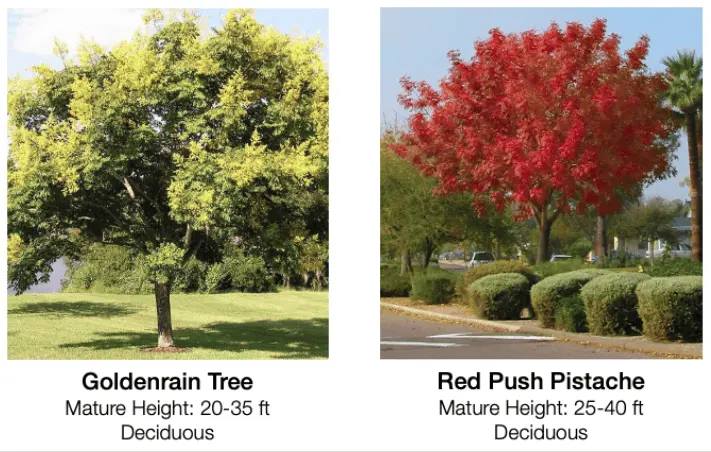
| Tree | Suitable regional setting | Approximate mature size | Main landscape use | Main limitation |
| Coast live oak | Suitable coastal and inland California sites | 30–80 ft tall, often wider | Broad evergreen shade | Needs substantial space and compatible irrigation |
| Oregon white oak | Summer-dry Pacific Northwest settings | 40–90 ft tall with a broad crown | Long-term shade and native habitat | Slow development and eventual size |
| Chinese pistache | Suitable warm inland and urban sites | 30–35 ft tall × 20–30 ft wide | Deciduous shade and fall color | Fruiting trees can spread seed |
| Desert willow | Hot, sunny Southwestern settings | 15–25 ft tall × 10–15 ft wide | Flowers and light shade | Open canopy and sensitivity to unsuitable drainage |
| Western redbud | Suitable California and interior Western sites | 10–20 ft tall and wide | Spring flowers and smaller spaces | Often develops several trunks |
| Strawberry tree | Mild, summer-dry coastal and inland settings | Often 8–12 ft tall and wide; some reach about 35 ft | Evergreen foliage and ornamental interest | Size varies; fallen fruit needs cleanup |
| Arizona cypress | Suitable sunny, dry Western sites | 40–60 ft tall × 15–20 ft wide | Evergreen screening or wind filtering | Too large for many narrow boundaries |
| Singleleaf pinyon pine | Dry inland and Great Basin settings | 15–25 ft tall × 8–20 ft wide | Evergreen specimen planting | Slow growth |
| Olive | Mild-winter, sunny settings | 20–30 ft tall, usually somewhat narrower | Evergreen structure or fruit | Cold exposure and fruit litter |
| Pomegranate | Warm sites with enough heat to ripen fruit | 12–20 ft tall and wide | Flowers and edible landscaping | Reliable fruit production needs adequate water |
Size ranges draw on university plant references and regional extension guidance. For example, Oregon State University’s Oregon white oak profile lists the species at 40–90 feet tall and notes its preference for dry summer soil. Smaller cultivars may differ substantially from the species ranges above.
Coast Live Oak
Coast live oak (Quercus agrifolia) can provide a broad, dense canopy in suitable California landscapes. Its evergreen foliage makes it appealing when you want shade and greenery throughout the year. Give it room to develop naturally. A narrow bed beside a driveway is unlikely to accommodate its eventual canopy and rooting space comfortably.
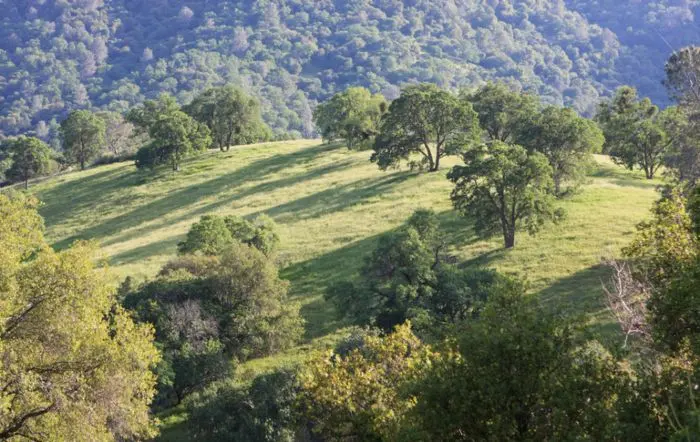
Nearby irrigation deserves particular attention. Frequent summer watering around established native oaks, especially near the trunk, can favor root disease. Supplemental water may still be appropriate during prolonged drought or in particular planted settings, so base the decision on the tree’s history and condition.
Oregon White Oak
Oregon white oak (Quercus garryana) is a deciduous native suited to many summer-dry Pacific Northwest landscapes. It develops a substantial branching structure and can become a lasting shade tree where space allows.
Choose it with a long view. Its slower development makes it a poor match when immediate screening is your main goal. An open planting area with compatible groundcover can suit it better than frequently irrigated turf. Oregon State notes its preference for dry summer soil and the potential for root problems with summer watering.
Chinese Pistache
Chinese pistache (Pistacia chinensis) offers deciduous shade and red-to-orange fall foliage. Its moderate growth and rounded mature crown make it worth considering where a medium-sized shade tree fits.
Check the cultivar and local planting guidance before purchasing. Male and female flowers occur on separate trees, and fruiting females can produce litter and seeds that birds spread. A named male cultivar can avoid fruit production, but local suitability still matters. This is especially relevant near natural areas.
Desert Willow
Desert willow (Chilopsis linearis) is a flowering Southwestern tree with narrow leaves and an open canopy. Despite its name, it is not a true willow. Its relatively rapid growth makes it useful when you want flowers and light shade sooner than a slow-growing species can provide. The canopy filters sunlight, so it will not create the same dense shade as a large oak.
Choose a sunny position with good drainage, and check winter suitability before planting in colder Western locations. Cultivar choice can also affect flower color, form, and seed-pod production.
Western Redbud
Western redbud (Cercis occidentalis) brings pink-to-purple spring flowers to a smaller landscape. Its rounded leaves and branching form provide interest after flowering finishes.
It often grows as a large, multistemmed shrub or small tree. If you want a single trunk beside a path, select nursery stock already developing that form rather than assuming every redbud will grow the same way. Allow space for its spread, even when its height seems modest. Well-drained soil and a suitable sunny or partly shaded position help it fit into a low-water planting.
Strawberry Tree
Strawberry tree (Arbutus unedo) combines evergreen foliage, bell-shaped flowers, and rounded red fruit. It can provide year-round greenery where a large shade tree would be excessive.
Check the botanical name and cultivar carefully. Some plants remain relatively compact, while older specimens can grow much larger. The common name also appears on other trees with different dimensions.
Consider what sits beneath the canopy. Dropped fruit is easier to accommodate in a planted bed than on a busy walkway. In suitable mild climates, good drainage and established roots help this tree cope with dry summers.
Arizona Cypress
Arizona cypress (Hesperocyparis arizonica, also known as Cupressus arizonica) provides evergreen foliage and a broadly conical form. It can serve as a screen or wind-filtering tree where its mature size fits.
The nursery label matters. Trees sold as Arizona cypress include different selections and closely related plants, with varying size and growth characteristics. Confirm those details before spacing a row. Full sun and well-drained soil are important. Avoid squeezing a large-growing selection between a fence and a building, where maintaining clearance could become an ongoing problem.
Singleleaf Pinyon Pine
Singleleaf pinyon pine (Pinus monophylla) is a drought-tolerant evergreen associated with dry inland Western landscapes. Utah State describes it as a slow-growing tree with very low water use and good suitability for Great Basin conditions. Its shape changes with age, becoming more rounded as the branches develop. That makes it an attractive specimen where you can appreciate the whole tree.
Choose it for its adaptation and character rather than a promise of quick privacy. Its success in dry inland conditions does not establish that it will suit a wet coastal planting site.
Olive
Olive trees (Olea europaea) are drought tolerant once established in suitable conditions. Their evergreen, gray-green foliage and developing trunk character make them useful ornamental trees in sunny, mild-winter landscapes.
Decide whether you want a harvest before choosing a cultivar. Fruiting olives can leave oily fruit on paving, while selections sold as fruitless generally reduce that cleanup. Some can still produce occasional fruit, so ask about the specific selection. For a fruiting tree, think through both harvest access and maintenance. Appropriate fruit tree care and fruit reduction can help manage fruit loads and mess around outdoor living areas.
Water needs also depend on your goal. An olive may survive dry conditions while producing a smaller or poorer-quality crop. For fruiting trees, irrigation can increase fruit production and size, so reliable production requires more attention to watering than keeping an established ornamental tree alive.
Pomegranate
Pomegranate (Punica granatum) combines colorful flowers with edible fruit and can grow as a shrub or small tree. Standard plants need more room than dwarf ornamental selections. Warmth matters when fruit is the goal. A site that keeps the plant alive may not provide enough summer heat to ripen a satisfying crop, and cold tolerance varies by cultivar.
Pomegranates can withstand dry periods, but extended drought can reduce fruit production. Choose a fruiting cultivar suited to your climate and plan for appropriate irrigation during crop development.
How to Choose the Right Tree for Your Property
Start with the conditions you have, then compare the trees that fit them. The best drought-tolerant tree for a broad, dry yard may be unsuitable for a narrow planting bed a few streets away.
Match the Species to Summer Heat, Winter Cold, and Rainfall
Check winter temperatures alongside summer conditions. USDA hardiness zones describe average annual extreme minimum winter temperatures; they do not tell you whether a tree will tolerate reflected pavement heat, dry winds, or months without rain.
Seasonal rainfall matters too. A species adapted to dry summers may struggle where its roots stay wet through winter. Native status is helpful context, but a native tree from a streamside habitat can have very different needs from one growing on a dry slope.
For example, a mild coastal Southern California garden, a hotter inland yard, and a Pacific Northwest property should not share an identical planting list. Where local habitat is a priority, native trees for San Diego landscapes provide a more focused starting point for that region.
Use the comparison table to narrow your choices, then confirm the final selection against local extension or municipal planting guidance.
Account for Soil, Drainage, Mature Size, and Nearby Irrigation
Before buying, confirm the tree’s mature size and crown characteristics, then check the whole planting area:
- How much direct sunlight does it receive?
- Does water drain away or remain pooled?
- How much room will roots and branches have?
- Are overhead wires, paving, or buildings nearby?
- Will lawn sprinklers regularly wet the same soil?
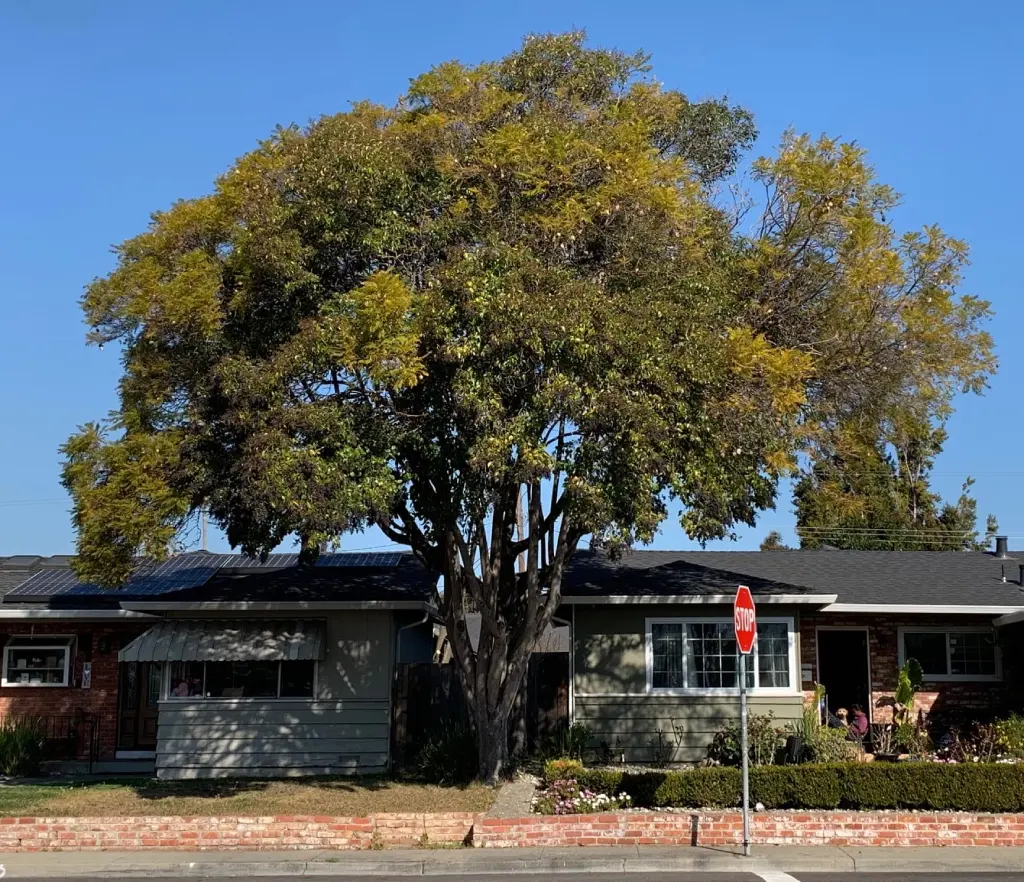
Picture two possible sites: an open, dry planting area and a narrow bed beside irrigated turf. A spreading oak might suit the first. In the second, both its eventual size and the watering arrangement could make it a difficult choice.
Also consider how the space will be used. Fruit over a parking area, low branches beside a path, or a broad canopy near a roof can create maintenance needs that a drought-tolerance label does not explain.
On fire-prone properties, include defensible space and fire management in the planting decision. Low water needs alone do not establish fire resistance. Placement, vegetation spacing, and ongoing maintenance need separate consideration.
Balance Growth Rate, Water Needs, and Maintenance
Among these options, desert willow offers relatively fast growth where its climate and soil needs are met. Chinese pistache generally grows at a moderate rate, while singleleaf pinyon and Oregon white oak require more patience. These differences help narrow the list, but they do not predict exactly when a tree will shade your patio.
Actual tree growth rates and timelines depend on species, root establishment, weather, and site conditions. A tree growing in compacted soil may develop very differently from the same species in an open planting area.
Consider what you will maintain as it grows. Evergreen trees still shed foliage, flowering trees may produce pods, and fruit trees bring harvest or cleanup work. Choose a tree whose mature form and seasonal habits fit your routine. Faster growth is useful when it supports that longer-term fit.
Help a Drought-Tolerant Tree Establish
A drought-tolerant tree still needs regular watering during establishment. Suitable planting weather and careful installation reduce avoidable stress. Where drainage, access, or tree size complicates the job, professional tree planting and transplanting can help match the installation to the site.
Give the new tree a practical start:
- Choose suitable planting weather. Favor a local planting window that avoids severe heat or an approaching hard freeze.
- Set the correct depth. Keep the root flare, where the trunk widens into major roots, visible at the soil surface.
- Check moisture before watering. Examine the root ball and nearby soil. A dry surface alone does not show what is happening below.
- Keep mulch clear of the trunk. Spread an appropriate layer over the surrounding soil without burying the flare.
- Check nearby irrigation. Lawn or flower-bed watering may leave the tree too wet or fail to wet its root ball adequately.
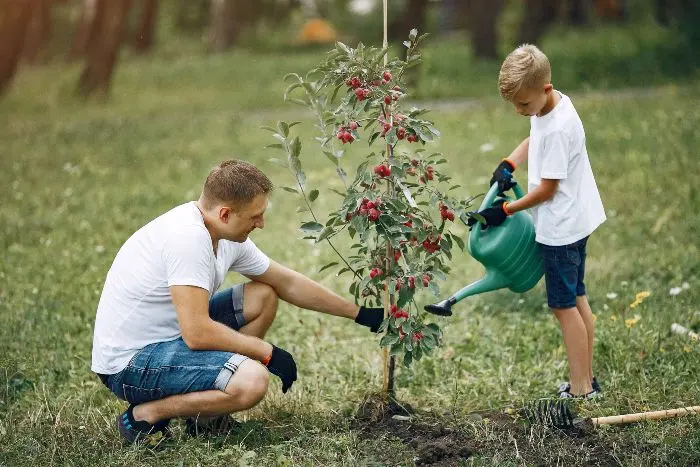
A consistent approach to watering newly planted trees should respond to soil moisture, rainfall, temperature, and root development. Apply water slowly enough to soak into the rooting area, then allow the soil to drain.
Reassess as roots spread. There is no universal anniversary when irrigation can stop, and an established tree may still need support during unusually long dry periods.
Frequently Asked Questions
Can You Grow Drought-Tolerant Trees in Containers?
Yes. Choose a compact species or cultivar and a suitably large, draining container. Limited root space means potted trees usually need more frequent watering.
Should I Replace a Healthy Tree With a Drought-Tolerant Species?
Not automatically. Assess the existing tree’s health, shade value, and irrigation efficiency first. A replacement needs establishment water and time to provide comparable benefits.
Get Help Choosing and Planting a Tree That Fits Your Site
A suitable tree should fit your climate, available space, and realistic care routine. Those details matter more than a low-water label on its own.
If you are unsure about drainage, mature size, or coordinating several new trees, we can help assess the site and narrow the choices. Talk with A Plus Tree about selecting and planting a tree that can establish well and remain a useful part of your landscape.
Get a Free Tree Assessment — No Obligation
Tell us about your tree. One of our ISA Certified Arborists will review your situation and get back to you within 24 hours.